
Globalizing the Greek Diasporas: Contested Hellenisms
by Yiorgos Anagnostou
It’s time we admitted the truth:
we are Greeks also—what else are we?—
but with Asiatic affections and feelings,
affections and feelings
sometimes alien to Hellenism.
— C.P. Cavafy 1914
I am the yield of alien soil. / Born here, in Australia, / I’ve learnt all I know of Greece from others’ lips. / What do you want from me? / Why do you seek, insistently, / to classify me? / It’s time you understood / that I have not just one / but two allegiances. / Neither to one am I pledged totally / nor fully to the other.
— Irini Pappas 1994
As a category of practice, “diaspora” is used to make claims, to articulate projects, to formulate expectations, to mobilize energies, to appeal to loyalties.
— Rogers Brubaker 2005
Introduction: The Terrain of Greek Globality
How does globalization today intersect with Greek people, their forms of expression, and their institutions? How does this process unfold within and beyond Greece—in the diaspora? Involving dramatic developments in communication technologies and dense human, cultural, and economic flows across state borders, globalization raises questions about homogenization as well as differentiation. This phenomenon—a process with a long history—does not merely produce sameness across the planet. Often, instead of seeking to forcibly assimilate local distinctions worldwide, it regulates them to advance the interests of its proponents. In response, national, ethnic, diasporic, and local oppositions emerge, often asserting their own globality.
How this plays out in the Greek case raises critical questions: how is this globality manifested, who produces it, and what is at stake? Engaging these questions constitutes a major undertaking, especially as a global sensibility proliferates across dispersed Greek populations and finds multiple articulations. Consequently, a sense of worldwide Greek belonging is experienced interpersonally, virtually, and imaginatively.
Practices leading to these identifications abound: educators initiate internet-based global learning networks to connect Greek language teachers and learners, while scholars organize discussions of global Greek Orthodoxy as a diachronic guardian of Hellenism. Satellite TV exposes audiences in Cleveland (Ohio) and Munich (Germany) to the same Greek cultural programming, and dating apps or websites devoted to e-tavli promote virtual intra-Greek interactions across the world. Furthermore, e-media with purposeful global outreach—the Greek Reporter for example—invites viewers and readers of Greek heritage in New York City, Athens, Cairo, and London to partake imaginatively in Greek cultural spectacles in Melbourne and San Franscisco.
Similarly, the Greek International Women Awards (GIWA) is now in its fourth year. Charter schools committed to Hellenic education aspire to promote global citizenship, while organizations and websites featuring the achievements of “global Hellenes” feed the imaginary of “global Hellenism” (παγκόσμιος Ελληνισμός), however variously defined. What is more, the Greek state historically engages with this narrative of worldwide Hellenism. Ultimately, the language of Greek globality and the practices that animate it are in full swing, moving in multiple directions.
By which route, then, should one decide to enter this terrain? What questions should one be asking? I choose to focus on the category commonly labeled as “diaspora,” which is broadly defined as (a) the scattering of a people due to migration or other forms of displacement; (b) the maintenance of continuing connections with a historical homeland; and (c) the formation of distinct, hyphenated identities in the new home. Following the seminal insights of Rogers Brubaker (2005), I approach diaspora as “a category of practice,” rather than “as an entity, a bounded group,” an ethnic demographic, an “ethnocultural fact,” or a host of static cultural characteristics (13).
As the epigraphs in the preface indicate, diaspora in this formulation entails a dynamic field traversed by contested claims, representations, cultural projects, and practices. Therefore, I examine a variety of narratives that depict dispersed populations connected by histories of mobility. I inquire into who confers a global identity upon these demographics, under what circumstances, and for what purpose. I also trace alternative counter-narratives and reflect on the stakes involved in these contestations. To find answers, I primarily draw upon scholarship from Greek and broader diaspora studies.
Methodological Issues and the Dominant Particular
The scope of this research is immense, requiring methodological reflection. A comprehensive discussion of the available literature at a global scale is virtually impossible at this stage—if indeed feasible by a single author—given the magnitude of the epistemological and linguistic challenges. Furthermore, historiographies of migration and diaspora fundamentally vary across national contexts due to differences in methodology and ideology (Βεντούρα 2004, 122). Additionally, not all nation-states approach internal cultural differences in the same manner.
Official policies differ not merely along the duality of assimilationism versus multiculturalism, but also along varying modes of multiculturalism across nation-states (Ang 2010). At the same time, linguistic variations in global scholarship require a multilingual command few, if any, could possess. This limitation confines me to Anglophone and Greek sources, a selection which, I am fully aware, reproduces cultural hierarchies. Ultimately, the inability to access knowledge in languages sidelined by the global marketplace compromises the analysis. It echoes the fact that the terrain of “globalizing diasporic Greeks” is uneven, as Greek populations in certain national contexts (Greek Americans, for instance) have been historically privileged due to their relative demographic and socioeconomic power, and their subsequent economic and political significance for Greece.1
Αn encyclopedic approach to the Anglophone and Greek scholarly literature is not suitable either. It would merely produce a restricted enumeration of case studies without an overriding perspective to relationally situate the various diasporic representations.
To address this quandary, I frame the analysis in relation to a historical clash over the meaning of Hellenism—a concept attached to multiple interpretations. In the context of the diaspora, it involves a struggle over the definition of Greek diaspora globality between two incompatible interpretive frameworks. The former, often labeled “Helladic Hellenism,” advances a nation-centric, insular rendition of “the diaspora” as a unitary extension of the nation. The latter represents an extroverted diasporic Hellenism shaped by cross-cultural encounters and the making of new identities via comingling.
A major thread in the analysis involves the cultural categories prevailing in the discourse of globalizing diasporic Greeks: metropolitan or national center, ethnicity, diaspora, omogenia, apodimos ellinismos and worldwide or ecumenical Hellenism. Far from being self-evident categories, these terms are social constructions requiring historical specificity. The term “diaspora,” for example, is understood broadly speaking in terms of two modalities: the homogenizing approach, which emphasizes shared descent, cultural continuity, sameness (a stable identity), and unbroken ties with Greece; and the contrasting view, which denotes cultural mixing, heterogeneity, historicity, and change (Venturas 2002)—a dynamic process of identity-making. Associated with nationalism, the first construes diaspora as an organic whole centered on Greece, which corresponds to Helladic Hellenism. Conversely, drawing from postmodernism, the second views diaspora as a network of historically contingent, multifaceted identifications corresponding to diasporic Hellenism.
Who is employing these categories and how? In what settings and for what purpose? What are the implications of each use? These questions organize this work. I closely examine the practices of the various social actors—the Greek state, scholars, journalists, and diaspora citizens—who participate in the project of diaspora meaning-making. I strive for specificity, primarily to counter a tendency within both the globalization discourse and occasional theorizations of diaspora to fall back on abstractions.
The notion of the “dominant particular” guides my theoretical outlook. Following Stuart Hall (1997a), “what we call ‘the global’”—a notoriously homogenizing and vague term—engenders plurality; it “is always composed of varieties of articulated particularities.” It follows that the “enunciation of a universal” expresses the “dominant particular” at the expense of alternative articulations (67). This raises the question of power: Who is authorized to enunciate this hegemonic narrative regarding globalizing diasporic Greeks? Who contests its power and how? How does all this connect with Hellenism?
I intertwine cultural analysis with historical inquiry. As cultural-studies-oriented anthropologists note, “history itself [is] inherently cultural, and culture, inherently historical” (Dirks et al. 1994, 6). The globalizing Greek discourse, along with the changing meanings of diaspora, therefore requires temporal grounding. I consider its construction since the 1980s across a variety of scholarly and political contexts—post-Soviet global capitalism (from 1989 onward), US Ethnic Studies in the 1980s, academic nationalism in the 1990s, deconstructionism and new diaspora theories since the 1980s, the so-called Greek debt crisis (2009-2018), and contemporary diasporic revisionism. I also trace connections with nineteenth- and early-twentieth-century Greek nationalism as well as the Cyprus crisis of the 1970s, among other analytical threads.
In this work, I offer an introductory albeit partial charting of the terrain of globalizing Greeks. Space does not permit me to cover a wide range of diasporic projects, such as the global interest in revitalizing the Greek language, or global Greek Orthodoxy in connection with Hellenism. Raising more questions than I can answer, I aim to contribute to an unfolding conversation from a position that foregrounds the ethical and political implications associated with the construction of Greek globality.
Helladic vs. Diasporic Hellenism
The state-driven definition of “global Hellenism” or “worldwide Hellenism” (παγκόσμιος Ελληνισμός) articulates the dominant particular in the discourse of globalizing diasporic Greeks as an entity: “the Greek diaspora.” These labels are currently used interchangeably with the ubiquitous omogenia (people of shared ancestry), apodimos ellinismos (Hellenism or Greeks abroad), diaspora, and “ecumenical Hellenism” as the “ultimate expression of the nation” (Venturas 2009, 134, fn. 19). They construe scattered Greek populations as a single collectivity based on descent and a common cultural heritage.
The criteria of biology2 and cultural continuity situate these demographics as an organic extension of the Greek nation—a transterritorial national whole. Cast as Helladic Hellenism or nation-centric Hellenism in debates about the meaning of Hellenism, this narrative endures in the Greek state’s construction of “the Greek diaspora.” It is widely reproduced in institutional, scholarly, journalistic, and popular discourses.
Rooted in the ideology of eighteenth- and nineteenth-century European nationalism, the construct of an organically connected nation extending across geopolitical borders circulated prominently in academic circles during the 1990s. Consider, for example, the following statement from a conference on “Greeks in English-speaking Countries”: “Imagine Hellenism as a butterfly whose trunk is the Greek motherland and its people, and whose wings are the Greeks in North America, Australia, and other lands” (Triantis 1993, 163).3
The metaphor of the nation as a living organism and Greek people everywhere as its vital components produces an undifferentiated national community—one serving state interests. In this paradigm of organic oneness, Greece functions as the vital center, while the affective and political contributions of the periphery toward it are rendered natural. Helladic Hellenism asserts this nation-centric and nationalist framework as “a unified, seamless whole”—a “universal, transterritorial Hellenism” that “became an increasingly attractive idea [and] was widely embraced beyond the political sphere” (Kitroeff 1997, 277, 284).4
The mobilization of Hellenism as a worldwide national community supporting Greece’s interests flourished, waned, and revived in key moments throughout modern Greek history. It was viewed as paramount during the irredentist project of the country’s territorial expansion (1844-1922), dissipating once the Great Idea collapsed in 1922. It was adopted by the regime of the dictator Ioannis Metaxas before being broadly revived as a national issue in the 1940s in the interest of Greek political aspirations. The post-1974 period was a catalyst for its consolidation. As Alexander Kitroeff (1997) points out, “The appropriation of the nation in post-1974 Greek political culture,” combined with the diaspora’s self-propelled reaction to the Cyprus crisis, connected the unity of Hellenism with the advancement of national issues at a global scale:
Asserting the unity of Greece and the Greeks abroad over these national issues provided Greeks with a sense of pride and a sense of presence on the world stage at a time when there was growing resentment in Greece over the treatment of the country by the United States and Europe (284).
Indeed, by the end of the twentieth century, nation-centric global Hellenism had “emerged as a new cultural ‘Great Idea,’ creating the illusion that Greece, despite being a small country, had a virtual empire thanks to its worldwide diaspora” (Tziovas 2009, 7).
Academic developments since the 1970s, however, have challenged the conventional positioning of the diaspora within the periphery or in exclusive relation to Greece. They have decentered it, contesting Helladic Hellenism as static, ahistorical, homogenizing and exclusionary of alternative modalities. Generated in connection with broader trends in the humanities and the social sciences—such as postmodernism and the politics of representation, ethnic studies, and new theorizations of diaspora and transnationalism—their critique operates at several levels: conceptual, theoretical, and empirical.
A programmatic report in the early 1990s articulated a revisionist perspective, situating the “Hellenic Diaspora” in relation to “its continuous reinventions of Hellenism” (Jusdanis et al. 1993, 49). Noting that Helladic Hellenism is an exception to the historical long durée of Hellenism, it calls upon researchers in Greek studies to recover the diaspora’s polyphonic, polycentric, and syncretic manifestations. It directs attention to its dissemination in the “new global culture,” which generates cross-cultural encounters, negotiations of difference, transformations, and cross-fertilizations.
“Diaspora identities are those which are constantly producing and reproducing themselves anew, through transformation and difference,” writes Stuart Hall (1994, 235), a seminal theorist in diaspora studies. Instead of embodying national sameness, Greek diasporic identities are inflected by their new surroundings. Across these different geographic and cultural contexts, they take on an accent of “affections and feelings sometimes alien to [Helladic] Hellenism,” as Cavafy’s lines in the preface evoke for Hellenism in Asia.
I refer to this mode of identification as “diasporic Hellenism”—a term frequently used in contradistinction to Helladic Hellenism. Involving encounters and negotiations with “otherness”—both dominant and minoritarian—it generates an outward, centrifugal Greek orientation, in contrast to the inward, centripetal focus of its nation-centric counterpart.5 Not all diasporic Hellenisms are identical; rather, they take shape in relation to the policies, politics, and cultures of each host nation-state. In this respect, the category “Greek diaspora” needs to be pluralized: Greek diasporas.
The grand narrative of unitary Hellenism, which often monumentalizes the identity—portraying, for instance, the diaspora as the capitals of columns supporting its edifice—was interrogated on multiple fronts. Sociological and ethnographic studies documented internal tensions and conflicts over the meaning of Greek identity within the ethnic group (Karpathakis 1994; Roudometof and Karpathakis 2002). Cultural studies deconstructed the homogenizing historiographies of Greek America (Kalogeras 1994). Scholars historicized state definitions of the global Greek nation (Venturas 2009; Vogli 2009, 2011). The nation was seen not as a natural organism but as a social construction—internalized and felt profoundly as real—and as driven by an exclusionary ideology that serves political interests.
Beyond the National Whole: Re-centering Greek Identity as Cultural Particularity
The heterogeneity within “global Hellenism” is empirically indisputable. While social discourse construes populations of Greek descent as a global nation, actual everyday encounters of diasporic individuals with mainland Greeks reveal major cultural and linguistic gaps and disconnections, including the circulation of hostile stereotypes (Christou 2006; Tsolidis 2009; Bratsis 2003).6 What is more, the ideology of Helladic culture as the authentic identity creates hierarchies of “Greekness” often expressed through the disparagement of diasporic identities as lesser. Indeed, “departure from the homeland is assumed to entail decline, degeneration, and misery” (Stewart 2006, 81). In turn, this negative evaluation generates counterclaims by diasporic subjects who view themselves as bearers of an “authentic Greekness” measured by their enduring attachments to folk culture, Greek Orthodoxy, and heritage.
This framing perpetuates essentialist ideologies of belonging, bracketing the understanding of Greek identity in terms of plurality or as a context-specific becoming. The conflict between “authentic” and “inauthentic” Hellenism reveals not only a rupture in the narrative of a unified Hellenism but also the irrelevance of the category of “descent” for understanding the histories and cultures of Greek mobilities. A descent-based narrative of national belonging works as a political technology to define who is Greek,7 while also reaching out to attenuated Greek demographics in an effort to revitalize their ancestral bonds to the historical homeland.
A major critique of this biologized ideology originated in US Ethnic Studies—the prevailing discourse engaging cultural difference in the 1970s and 1980s. This intervention questioned the Helladic view of diasporic Greeks as an organic extension of the nation or as mere transplanted nationals.
Weighing in on the appropriate framework to conceptualize US Greeks, sociologist Charles Moskos (1980) contrasted two competing models at the time: the Helladic lens, which positioned Greek Americans as omogenia—a “Hellenic diaspora”—and the alternative of “American ethnics,” who were to be understood “in the broad context of the ethnic experience in the United States” (146), as participants in its history. He favored this latter approach as the best-fitting the experiences of American-born Greeks.
In his reasoning, this demographic could not possibly be understood independently from its US historical context. An ethnic group is primarily shaped through pressures for assimilation, acculturation, and negotiation with the new home, and to a much lesser extent through the distant realities in Greece, he argued. He proposed the term ethnogenesis—in currency then in the sociology of ethnicity—to underline the process of ethnic identity transformation.8
Though Moskos did not consider new theorizations of diaspora, his empirical sociology nevertheless undermined its nation-centric ideology: the notion of a unified global community did not stand up to close scrutiny. In this respect, he implicitly recognized what is widely accepted today: namely, that “shaping or pointing up similarities” in diaspora discourse operates as an ideological tool by “concealing differences and changes in identification over time” (Venturas 2009, 125). By masking the multiplicity of Greek identities across the world, Helladic Hellenism negates the historicity of the diasporas.
Conventional expressions of diasporic identity as a connection to Greece were undoubtedly at work, as Moskos observed. Examples included the Greek American lobby, family ties with the place of origin, regional organizations, heritage travel, and Greek language schools. The “sensibility of an American ethnic” (146) was nonetheless inflected by diasporic affiliations with the historical homeland. Yet, the influential sociologist privileged ethnicity—defined primarily in terms of culture, not descent—as the preferred identity designation for Greek Americans, undermining the ideology of global Greek sameness in favor of ethnic particularity. He shifted the discussion from a transterritorial national wholeness to an ever-evolving ethnic specificity that also exhibited transnational connections.
Starting in the late 1980s, however, a host of worldwide developments decisively tilted the preference toward the term “diaspora”—a designation meant to denote bonds with the historical homeland, that global institutions, academic discourses, and Greek diasporic sectors embraced in earnest. While the concept of diaspora gained prominence, the categories “ethnicity” and “ethnic group” receded from analytical currency.
How does one explain this transition from authoritative assertions about the analytical value of ethnicity to narratives celebrating scattered co-ethnics as a worldwide diaspora? Two historical moments—the collapse of the Soviet Union (1989) and the Greek debt crisis (2009-2018)—had a catalytic impact in consolidating the discourse of global Hellenism, fusing the terms “ethnicity” (descent and subculture), omogenia, and “diaspora.”
Re-framing Diaspora as “Best Practice”: Post-Soviet Geopolitics and Global Hellenism
The collapse of the Soviet Union heightened the geopolitical expansion of capitalism, generating worldwide transformations, including the enhancement of the value attributed to diasporic populations. For powerful multicultural democracies such as the United States, Canada, Australia, New Zealand, and countries in Western Europe—as well as global financial institutions—these communities, defined as ethnic populations conscious of their historical homeland, were heralded as agents advancing mutual economic and geopolitical interests for both the hosting and sending countries. In government and corporate discourse, the term became the option of choice. Such groups, particularly economically robust and assimilated ones, were legitimized as valuable assets. They were touted as key players in public diplomacy, mediating between their home country and historical homeland in the interest of regional stability. Furthermore, they were promoted as a best practice for global investments, knowledge exchange across transnational professional and scientific communities, and potential contributors to modernizing reforms in their respective homelands (see Anagnostou 2017).
The international recognition of diasporas as vital transnational actors and sources of revenue propelled or enhanced—as the case might be—the globalizing orientation of countries historically producing diasporas. For a country such as Greece, the conditions for accelerating a sustained policy regarding worldwide Hellenism were favorable. The shifts in the post-Soviet political and economic geography in the region presented new opportunities for Greek economic expansion in the Balkans and the Black Sea, a development that in turn rendered local ethnic populations vital assets to state diaspora policy.
Previously neglected, these demographics were now “discovered” (Venturas 2009, 134) as a mediating force for brokering bilateral relations and fostering national economic interests in the broader region, thereby facilitating Greece’s entry into emerging markets. Political considerations in the early 1990s were also at play, given that sectors of the Greek diaspora mobilized on behalf of Greece’s perspective regarding the “Macedonian issue.” The precedent of the diaspora’s rallying in connection with the Cyprus crisis in 1974, combined with this nationalism from afar in the early 1990s, elevated the diaspora’s importance as an advocate of the homeland’s national interests.
Historicizing these developments, Lina Venturas (2009) dissected the Greek state’s intensified engagement with demographics of Greek descent abroad, identifying its policies and objectives. The benefits Greece could derive from “the diaspora” were plentiful: “to attract foreign investment,” to “get international political support,” to “counterbalance its marginal position in the EU [European Union] and on the international scene,” and to “strengthen its economy in world markets” (135). In this historical juncture, the state reinforced its historical role as the metropolitan center via the 1995 founding of the World Council of Hellenes Abroad (SAE). This “organization of organizations,” aimed to serve as “essentially, a parliament of Global Hellenism” (Frangos and Anastasakis 2022, 181) while expressing “the ecumenical unity of Hellenism” (Venturas 2009, 135 fn. 22).9
The 1990s then marked an intensification in the state’s historical project to harness the political, economic, and cultural capital of Greek populations across the globe. This involved deploying the diaspora as a resource for advocating national issues, generating investments, encouraging “diasporic tourism,” facilitating the international expansion of the country’s economic interests, empowering Greek diplomacy, and enhancing Greece’s global standing.
In this landscape, the term “diaspora” gained new currency in Greece as well as among worldwide Greek communities. Embraced widely by global institutions, its use in official narratives in Greece increased, albeit reluctantly. “For the Greek authorities, who still perceive diaspora communities in ethnocentric terms as Greeks abroad,” Dimitris Tziovas (2009) writes, “the term ‘diaspora’ is synonymous with globalization, and as something which threatens the integrity of the nation” (7).
If global capitalism in the 1990s and 2000s elevated the importance of the diaspora for Greece, the global financial crisis (2007-2010) created a new position for it. With its rippling effects on Europe’s weaker economies leading to the Greek debt crisis, this macroeconomic shock forced a reevaluation of diaspora engagement.
This reconfiguration was not merely about extending material assistance, a conventional expression of solidarity with Greece historically. It also involved a response to a cultural threat attached to the economic one: the devaluation of the global image of Greeks. The counter-response involved a diaspora-generated narrative seeking to redeem the country’s reputation internationally. By resorting to an ethnic myth of cultural identity determined by ancestry—yet presented as legitimate anthropological truth—this narrative once again advanced the ideology of descent to construe a uniform global nation of inherent moral and supreme cultural value.
Disrupting the Center, Reproducing Its Ideology: The Debt Crisis and the Rise of Diaspora Power
The role of Greece as the center of global identity production was disrupted in 2009 when the financial toll of the state’s economic bankruptcy and the subsequent humanitarian, social, and political crisis severely plagued the country. The so-called Greek debt crisis marked a new era in the nexus of “diaspora-homeland” relations. Greece’s centrality receded during that period, while the cultural and economic power of diaspora commanded the spotlight. SAE, an ailing institution by then, “[fell] into irrelevance” (Frangos and Anastasakis 2022, 182). At the same time, new diaspora organizations were created with the explicit aim of contributing to Greece, while existing ones mobilized—albeit belatedly after initial reluctance—to support the homeland (Kitroeff 2022; see also Mavroudi 2015). The crisis brought to the surface historical diasporic ambivalences toward Greece, deepening distrust and frustration over what many considered to be the repeated failures of Helladic Hellenism.
Still, the crisis consolidated the importance of the diaspora for Greece, not simply as economic capital but also as cultural capital. Most visible were newly minted, diaspora-generated narratives and practices asserting Greek pride and value to compensate for the global devaluation of Greeks as the culprits for their own plight.
The diaspora assumed a leading role in spearheading effective aid to Greece. As the exit of more than 500,000 Greeks created a new diaspora—the so-called brain drain—this crisis infused the diasporic field with a new power. This force manifested in a variety of projects that mobilized philanthropy, civic support, professional expertise, and capital to re-energize Greece, while simultaneously branding Greek identity for international consumption (Anagnostou 2021). These initiatives sought to rehabilitate Greece’s tainted image in the global imaginary and address the country’s grim economic and humanitarian realities.
Specific expressions of this outreach included organizations such as Reload Greece, ReGeneration, and The Hellenic Initiative (THI)—a global diaspora movement founded in 2012—among others, organized to channel direct social support and economic revitalization into the crisis-stricken homeland. These programs placed the diaspora in an internationally central, restorative position. This work achieved significant success in its function as public diplomacy, receiving endorsement at the time by the US government (Anagnostou 2022).
Scholars discuss these developments along two axes. A major, policy-oriented research corpus focuses on the altered institutional landscape of “diaspora-Greece” relations, aiming for its restructuring. Identifying the “limits and failures,” and, indeed, the “outdatedness of the previous system,” it proposes a “new model of diaspora engagement” (Anastasakis et al. 2022, 435). This scholarship confronts the homogenizing narrative of a single Greek diaspora. Casting the crisis as a “critical juncture,” it recognizes the existence of multiple diasporas “with different socio-political agendas,” and varying “levels of attachment to Greece” (435)—and, one might add, distinct histories and cultural trajectories. This corpus calls for particularizing Greek ethnic populations abroad in their respective national contexts, positioning them within the framework of diaspora engagement and policy. Ultimately, it contributes to a still nascent post-SAE conversation on diaspora governance.
The second axis of inquiry engages critically with a particular diasporic response to the crisis. It identifies a new identity narrative—produced in Greek America and embraced across Greek globality—that interweaves ethnicity (descent), diaspora (worldwide, scattered Greek populations), and nationalism (ethnic and cultural sameness) in the construction of a global Greek identity.
This discussion places a Greek ethnic group (US Greeks) in a triadic relation: (a) the group’s historical interest in acquiring prestige in its new home (United States); (b) its diasporic affiliation with the historical homeland; and (c) the power of American society to mediate the scope of diaspora representations. Drawing from scholarship that views diaspora as a “category of governmentality,” this analysis examines how political and economic structures regulate the boundaries of transnational exchanges and, in turn, govern the meaning of diaspora (Anagnostou 2017). A closer look at this dynamic is in order.
From “Model Ethnics” to a Distinguished Global Nation: Philotimo and the Politics of Identity Branding
Diasporic populations are subjected to twofold regulatory frameworks. Their assertion of cultural otherness within their new home does not happen independently from governmental mechanisms seeking to control the range of their difference. In this context, a specific dialectic is at work: while the governments of ancestral homelands seek to enhance the loyalty and bonds of their diasporas, host governments simultaneously seek to contain these affiliations—whose intensity could be seen as a cultural and political threat—for the purpose of national cohesion. Multiculturalism, after all, represents a mode of governmentality that serves as a “national management of ethnically diverse populations” (Ang 2010, 1). Consequently, diasporas are subjected to formal and informal operations of power that delimit the expression of cultural diversity within their respective host nations.
Sectors of the diaspora consent to this containment. Since the 1980s, European American narratives have embraced prevailing political prescriptions regarding acceptable norms of ethnic identity. Representations of idealized culture and history abound in Greek America as a strategy to attain broader approval and prestige, positioning them as “model Americans and quintessential ethnics” (Anagnostou 2003).
The currency of stereotypically positive self-representations––a narrative with deep historical roots in Greek America—served as a foundation in the forging of a new global ethnonational narrative during the Greek debt crisis. Confronting the devaluation and maligning of Greek identity in Western media, and its scornful portrayal of Greek people as villains, a network of Greek American institutions responded with a counternarrative celebrating the modern successes and achievements of their co-ethnics as the result of their intrinsic moral worth—namely honor or philotimo.
The source of this narrative—Greek America—was by no means fortuitous. Assimilated into the national fabric and noted for its socioeconomic distinction, this diaspora served as an authoritative site to assert the moral and cultural worth of Greeks. Biologizing honor as an essential ethnic attribute, the narrative represented a textbook example of identity branding. Projecting the value of “Greekness” globally, this discourse became institutionalized, disseminated broadly in the United States, circulated across the diaspora through transnational media, and was embraced worldwide as a badge of Greek pride. This globalizing and globalized ethnonational narrative simultaneously safeguarded the positive reputation of both the elite producing it and Greek people everywhere. In this ecumenical claim for inherent Greek cultural greatness, ethnicity (as descent-determined culture), diaspora, and the nation conflate into a single global identity.
Under conditions threatening the Greek reputation internationally, the diaspora deploys two principal elements of Helladic Hellenism—biologized identity and shared culture—to brand a global narrative. In this historical juncture, this population possesses the legitimacy to assume a leading role in turning Helladic Hellenism into an idealized global cultural commodity.
Still, the articulation of an alternative particularity—diasporic Hellenism, which advocates historicity instead of ideality—has been gaining traction in the public sphere. Its ascendancy is due to several convergent forces. First, there is growing resentment toward the Greek state’s paternalism. Second, there is an emphatic interest in self-narration, which leads to assertive and widely acclaimed representations in the arts and intellectual life showcasing diasporic identities and histories as multifaceted. This shift is further reinforced by the recognition that diasporic experiences vary from Helladic identities, and by the circulation of new theories and imaginaries of diaspora. Together, these forces contribute to a zeitgeist—particularly visible in Greek Australia—that directly confronts the ideology of the ahistorical global Greek nation.
The Construction of the “National Center”
In the political and cultural geography of global Hellenism, Greece has historically staked a claim to commanding the national center. The state’s institutional role as the guardian of national culture legitimizes this position. The view of assimilation and globalization as threats to worldwide Greek heritage offers the political raison d'être for Greece’s functioning as its committed cultural custodian. Hellenism is nationalized as a defense against globalization, while state-sponsored narratives are utilized to (re)produce this identity for national interests.
Legitimizing this centering are state practices empowering Greek culture and language internationally, supported by a transnational network of researchers embracing the Helladic narrative. For two decades (1990-2010), Greek law guaranteed the state’s extensive support for Greek language education institutions–in the 1990s alone the state spent the equivalent of “around 60 million euros a year” for this purpose (Venturas 2009, 133 fn. 15). This was before crisis-related budget cuts scaled back this ambitious educational policy. But the outreach continued. Greek consulates actively promoted cultural events in communities, institutions, and academic programs. Extending voting rights to individuals of Greek ancestry further sought to contribute to the (re)production of the diaspora’s bonds with Greece–the core aim of diaspora policy. By establishing a state presence across overseas communities, these legal measures carve out a deterritorialized national space that enhancing the country’s position as a metropolitan center.
The ubiquitous term Apodimos Ellinismos (Hellenism Abroad)—most recently employed to designate the diaspora in the state’s strategic plan—expresses, once again, the ideology of an organically connected transterritorial national Hellenism. Referring to emigrant Greek populations as well as their descendants, this narrative underscores their enduring national belonging. Their bonds with the historical homeland are portrayed as natural and therefore inevitable and unbroken, while their identifications with the national interests of their new homes are seen as of lesser significance, or even as something foreign (Γκότοβος 2008, 73).
The “Hymn of Apodimos Ellinismos” (2022), produced with the support of the General Secretariat for Greeks Abroad and Public Diplomacy, is a case in point. Employing the imagery of Greek migrants as migratory birds that have flown away from their original nest—Greece—this musical piece underscores their natural ties. Aiming to generate feelings of deep belonging and bonding with the country, the hymn participates in the political project of nationalizing global Hellenes.
Crucially, the metaphor of migrants as migratory birds reveals the mythopoetics of Helladic Hellenism. Myths validate ideologies while concealing realities. They are meant to instill shared beliefs and sentiments—in this case, constituting national subjects—but at the same time they can insult and injure. The casting of emigration as a natural phenomenon artfully diverts attention from its political and economic causes.
Indeed, Greek governments were deeply involved in the various emigration waves in the country’s modern history. State policy encouraged or generated emigration as an answer to unemployment, and as a mechanism to avoid social unrest and political dissent. Greek consulates also persecuted migrants who were involved in the anti-junta movement, threatening their families in Greece with retribution. Obscuring the material and political history of migration, this narrative insults those who were forced to emigrate due to poverty or political ideology, as well as their children who witnessed this often-traumatic displacement. Instead of celebrating diasporic populations, the hymn—the voice of the Helladic nation speaking on their behalf (“we who, like birds, flew away from our original nest”)—misrepresents their experiences, violating historical memory (see Αναγνώστου 2022).
Decentering the National Center: Resistance and Diaspora Agency
A diasporic discourse contests the ideology of Greece as the center of global Hellenism. The critique is expressed in several institutional contexts, including, notably, the World Council of Hellenes Abroad (SAE), an organization whose founding in 1995 sought to crystallize the state’s position as the metropolitan center. Although officially cast as a non-governmental entity, SAE was in fact “dominated by the Greek government” (Frangos and Anastasakis 2022,188). Its mission to serve as the hub of a “global network” providing programs “for the benefit of the Omogeneia” (184) was criticized as paternalistic “governmental interference” and openly resisted (188). Delegates and organizations demanded explicit disassociation from—or “any direct link” (185) with—the Greek state. As citizens of other countries, these delegates viewed themselves as sovereign enablers, rather than as consenting national subjects. They challenged Greece’s position as the political center, making the case for greater diasporic agency in matters of policy.
Public interest in the question of the national center is unevenly distributed across the diaspora. Opposition is most vocal in Greek Australia, where critique targets corruption and inefficiency in Greece (Mavroudi 2015), alongside persistent resentment toward the state’s paternalism in matters of diaspora governance and cultural representation. While Greek American leaders and commentators have occasionally voiced similar criticisms, “resistances to the ‘national center’ are of a smaller scale” in Europe (Tziovas 2020, 651). This milder reaction is perhaps due to Greece’s relative geographic proximity, which facilitates frequent visits and an imaginary of return, as well as the political affinity stemming of Greece’s membership in the European Union.
The political desire to decenter Greece—and by extension, Helladic Hellenism’s authority to speak for the diaspora—manifests as a rejection of this dominant identity narrative and a refusal to be represented by it. This opposition takes the form of insisting on diasporic self-representation, which frames identity as historically specific, syncretic, and multiple. Consequently, the narration of individual subjectivities, family histories, and diasporic struggles provides a measure of autonomy from Helladic control.
Diasporic identities produced between the sending and the hosting cultures–as Irini Papas’s stanzas in the preface illustrate—occupy a cultural “betweenness” that transcends nation-centric frameworks. The disjuncture between the poetic subject’s diasporic sense of self and the prescriptive national paradigm of identity it encounters (and which seek to correct her), underscores what Ian Chambers sees as universal in the creation of new modes of identity and belonging: the “unstable point where subjectivity meets the narrative of history” (in Cohen 1997, 133). Diasporic Hellenism brings visibility to marginalized histories and modes of expression through processes of self-fashioning, becoming, and identity poetics. As James Clifford (1994) notes, narrating histories of displacement, struggles of adaptation and resulting cultural complexities “may be as important as the projection of a specific origin” (306).
Articulations of diasporic Hellenism flourish across Greek Australia and the broader Australian cultural landscape.10 The diasporic poetic space of Kalliope X leaves a mark on the literary life of Melbourne and beyond. The polyphonic narratives compiled by Helen Vatsikopoulos (2024) are expressed through diverse conceptions of identities along the intersections of region, gender, class, and sexuality. Within this framework, the arts reinvent relations with cultural traditions while experimenting with bilingualism, producing regional, transcultural, and cosmopolitan renderings.11
These narrations elucidate how the historical trajectory of traumatic dislocation and discrimination has variously shaped individuals, families, and organizations as members of an exploited and devalued migrant minority. They demonstrate that negotiating a dominant society from various subject positions results in multiple affiliations and loyalties.
What does this proliferation of diasporic histories and cultures—by no means universal across Greek demographics—accomplish? It legitimizes Greek Australia’s claim as a center. Its diverse literature, photography, poetry, cinema, and scholarship have garnered visibility in broader Australia and earned the “community” prestigious accolades. These achievements are primarily but not exclusively produced in English or bilingual formats, engaging in conversation with contemporary literary, artistic, and scholarly ideas. Notably, this cultural output confers distinction upon Greek identity.
The Polycentric Network: Ethical and Political Implications of Diasporic Hellenisms
A novel imaginary of global Hellenism has been in circulation. Its visual cartography moves away from metaphors of organic oneness toward a portrayal of Greek globality as a web of interconnected centers that are neither coherent nor free of discontinuities or structural gaps. It gains currency in the iconography of the scattered Greek worlds configured as a galaxy—as exemplified by the poster announcing the Third International Conference on the Hellenic Diaspora, organized by Charles Darwin University (2022).
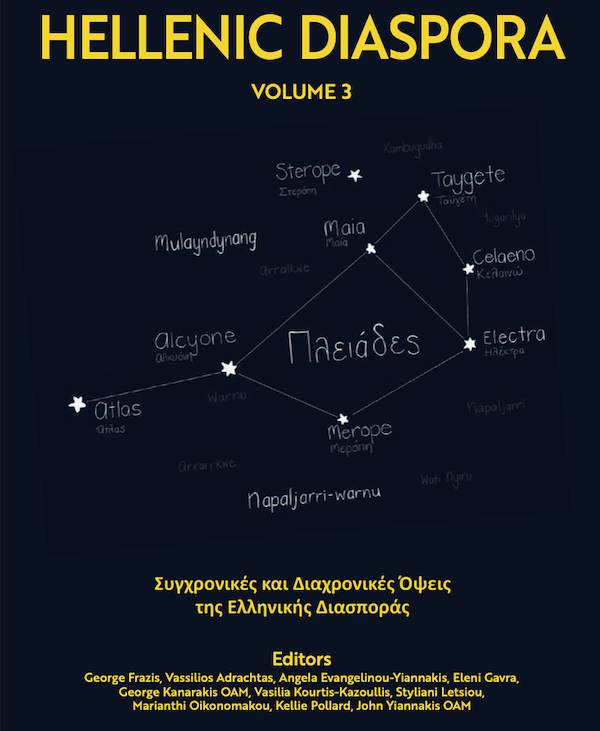
This alternative rendition highlights the complex relations within the “Greece-diasporas” network, emphasizing “their simultaneous autonomous situation,” while directing attention to neglected or obscured inter-diasporic linkages (Kanarakis 2012, 297). Navigating such a conceptual mapping requires careful theoretical development, yet it concurrently opens up space for comparative projects across diasporic contexts, now well underway.
The planetary metaphor reconfigures the “diaspora” imaginary from a uniform entity to a polycentric network. It expands the conceptual terrain to include relations across localities, global cities, and regions, rather than just transnational contexts. This revisionism interrupts the ideology of Helladic Hellenism, recognizing the richness of diasporic Hellenisms and their centrifugal potential. It stems from a recurrent grievance that the Greek state and those who support its official paradigm neither understand the diaspora nor have the capacity—or willingness—to embrace the narrative of diasporic Hellenism.
“The national center,” Athanasios Gotovos (Γκότοβος 2008) writes, “must learn to accept alternative interpretations and versions of Hellenicity beyond what it habitually recognizes” (74). Expressed both in the media and the academy, this discontent drives the demand to refashion the globalizing narrative by embracing syncretic subjectivities and diasporic historical and cultural particularities. Such rewriting more effectively addresses the diversity of the field, alongside the aspirations of citizens for active civic participation, diasporic self-expression, and distinction within their new homes.
Greek Australia’s articulation of diasporic Hellenism asserts explicit political claims. By resisting the power-knowledge dynamic of Helladic Hellenism—the dominant particular—as the sole arbiter of Greek identity, this discourse calls for structural change. Specifically, it confronts the state’s production of cultural authenticity alongside the hierarchies it generates, countering ahistorical renderings that erase a range of diasporic experiences and subjectivities. Furthermore, it demands recognition of multiple loyalties and the diaspora’s function as a political community that deliberates and applies its own judgment to both Australian and Greek issues (Καραμάρκος 2024; Βασιλακόπουλος & Νικολακοπούλου 2024). Once we recognize that “by definition,” culture is “situated in a field that is mediated through difference,” it becomes “difficult if not contradictory to envision a ‘universal’ or ‘global’ culture” (Weinbaum and Edwards 2000, 259).
In this respect, the way diasporic Hellenism decenters Helladic authority represents a fundamental resignification of global Greek identity. Specifically, ecumenical Hellenism is understood not as the property of a single nation, but as a cultural field universally open to local interpretation and engagement. Opposing homogenization, diasporic Hellenism advocates an ethic of inclusion. Its conceptual contours bring visibility to historical realities and diverse demographics that nationalizing narratives have long suppressed.
The discourse maps global Hellenism as a multifaceted network of alternative articulations. In doing so, it rejects the Helladic narrative—the “dominant particular”—including its portrayal of transnational Greeks as lacking engagement with—and loyalties to—their own pasts as well as contemporary cultural and social dynamics beyond Greece. Ultimately, this framing invites deeper inquiry into how these localized communities aspire to contribute to the major civic and cultural challenges debated within their respective home countries and their own local communities.
What is the Greek state’s position regarding the revisionist call by those espousing diasporic Hellenism? In the Strategic Plan for Hellenism Abroad 2024-2027—the most recent institutional articulation of the “Greece-diaspora” relations—the government seems to be taking initial, albeit tentative steps toward addressing its diasporic critics. The plan outlines, in broad strokes, the multidirectional differentiations within and across the Greek diaspora. It also emphasizes the importance of academic work that produces knowledge about particular communities. For instance, it includes a specific mention of the Hellenic Heritage Foundation Greek Archives at York University, while embracing the idea of establishing a museum of “Greeks Abroad.”
Is this a gesture signaling the political resolve to begin structurally revising the narrative of “the Greek diaspora” into that of diasporic Hellenism? Or is it merely a public diplomacy move designed to win hearts and minds? The plan’s diasporic reception—ranging from a balanced to a trenchant critique—acknowledges these modest promises while demonstrating skepticism and frustration over their omissions and limitations. The basic Helladic element of Greece as the metropolitan center remains intact, and several of the plan’s promises are viewed as “cosmetic and rather frivolous […] [an] approach that tends towards smoke and mirrors rather than substance” (Kalumniou 2024; see also Karamarkos 2024 and Τριδήμα [2024).12 In some social spaces, the fault lines between Helladic and diasporic Hellenism seem to open wider.
Conclusion: Reconfiguring Greek Diasporic Articulations in the Global Imaginary
This work investigates Greek diasporic articulations in relation to an array of issues: the nation-state and its regulation of identity; the politics of historical memory; institutions and individuals negotiating difference; the politics of cultural representation; and global cultural hierarchies. This involves a complex web of intersecting discourses—including modalities of multiculturalism, the regulatory power of nation-states, global capitalism, and empowered nationalisms—within which Greek diasporic subjects in Birmingham (Britain), Marseille, Ann Arbor (Michigan), Buenos Aires, Auckland (New Zealand), and Columbus (Ohio) make claims, articulate projects, and formulate life expectations (see Brubaker 2005).
Within these frameworks, diasporic people across the world are immersed in webs involving globalization and the question of class inequalities; colonialism and its aftermath; the commodification and exoticization of cultural otherness (Hall 1997b); local resistances to grand narratives; and diasporic citizenship addressing global concerns such as racialized discrimination and environmental pollution. Relevant examples pertaining to the Greek diasporic field span a broad spectrum, ranging from tourism and neoliberal practices to issues of social justice, gender equality, and poverty—the last of which is rarely if ever addressed.
A selective overview of this milieu includes Southeast Asian tourists visiting Melbourne to experience its famous Antipodes festival—an intersection where the tourist industry meets the commercialized spectacle of Greek identity. It also entails organizations such as The Hellenic Initiative reaching across several diasporas to connect with Greece on multiple levels, ranging from supporting reforestation projects to transnational investments in neoliberal contexts. Further examples include the first global summit of Hellenic lawyers on “safeguarding democracy, the rule of law, and justice,” which took place in Athens in 2025; cultural activists from Australia organizing “World Women’s Conferences” in Greece; networks of online Greek global media; and Greek cultural intersections with global mass culture. Additionally, this landscape features the globalization of folk dances and rebetika music as markers of Greek identity, as well as scholars reframing Greek diasporic experiences in relation to histories of global whiteness and settler colonialism (Piperoglou 2026).
These developments unfold at a time when, most pressingly, we are called to reflect and act on “the sense of emergency that conditions contemporary life globally” (Spiropoulou 2025, 293). This critical juncture involves a widespread global assault on the value of the humanities and the social sciences, along with the hardening of multicultural states against critiques of the nation and the subsequent tightening of the regulation of difference. Simultaneously, global, national, and local forces continually press for celebratory heritage at the expense of historical understanding.
Such pressures undermine press freedom and fuel the upsurge of authoritarianism alongside forced migration in the context of racialized hierarchies. They also shape the experiences of the working poor and the lower-middle class at a time of dramatically uneven distributions of global capital, wherein golden visas and global tourism lead to skyrocketing of real estate prices and rental costs. This terrain further encompasses the continuous exploitation of migrant workers, often by co-ethnic employers, as well as ongoing radical shifts in the direction and ideology of globalization that challenge scholarly assumptions and concepts.
How does one study Greek globality in this historical moment? This new state of emergency prompts researchers to engage with the hegemonic forces promoting nation-centered interpretations of the diaspora, ahistoricism, and inequality. At the same time, it calls for a reflection on the role of scholars and intellectuals in deciding which research questions they prioritize—and for what purpose (see Spiropoulou 2025).
A central question concerns how diasporic identities engage with globalizing forces in micro-social spaces, such as political protests, historical monuments, classrooms, or social venues. Scholars have already begun to situate these dynamics, exploring how specific contexts intersect with phenomena such as industrial capitalism, whiteness, settler colonialism, and the normalization of identity (Molos 2026). They also investigate how civic activism contests hierarchical racialization and expresses solidarity with vulnerable demographics.
Comparative work presents an exciting frontier. Globalization is an uneven and contradictory process that is expressed differently across nation-states, regions, urban versus rural settings, and gentrified versus underdeveloped neighborhoods. For instance, scholars have compared the Francophone literary representation of Greek migrant subjectivity in a multitude of geopolitical settings (see Αντωνιάδου 2008-2009). One could likewise imagine projects examining how, for example, Greek laborers negotiated their experiences as miners in the context of early-twentieth-century industrial capitalism in locales across the globe—including regions in the United States, Belgium, Australia, Africa, and Greece. Such research illustrates how a specific form of global power—which caused unspeakable suffering and exacted a high toll in human lives—was manifested and negotiated locally.
Yet, this remains an ideal. Greek cultural production in the context of globalization—a fluid, constantly shifting process—presents formidable challenges for Greek diaspora studies. This academic field operates precariously, lacking the necessary institutional power and human resources to flourish, or even survive, in some settings. This structural scarcity limits the capacity of analytical inquiry to follow the frenetic proliferation of narratives globalizing Greek communities, leaving a plethora of such expressions unexplored. Such gaps in reflective scholarship are consequently filled by readily produced nation-centered and neoliberal interpretations of the diaspora, which only add to the issues requiring critical attention.
How does one empower the project of critical diaspora studies? Recognizing the stakes in the pressing issue of Greek globality, researchers have been advancing initiatives to place this scholarship in conversation with broader questions raised by historical, cultural, and postcolonial studies—thereby expanding its audience and institutional valence. At the same time, the current transnational moment opens fertile opportunities for both established and emerging scholars working in modern Greek studies to engage with their counterparts in the diasporic field.
“We looked for representations of Greekness that productively unsettled us with their unfamiliarity,” Bolcakan et al. (2018) write in their exploration of world Hellenisms. Several of the diasporic intersections with globalizing forces that I examine in this work raise issues unfolding within Greek society: the debate over Greek globality, the construction of syncretic identities and artistic expressions, the experience of living with difference and its representation, the emergence of hegemonic narratives normalizing Greek identity and historical memory, and the place of “diaspora knowledge” in the domestic politics of difference in the country.
This serves as a reminder, if one is needed, that the boundaries between modern Greek studies and diaspora transnational studies are inextricably intertwined. The current moment offers an ideal opportunity to imagine a closer alliance across these two academic fields at a time when globality makes their demarcations even more porous. Scholars might be surprised at the unsettling unfamiliarities that such crossings could reveal.
September 05, 2026
Author’s Note: This work was completed in the fall of 2025. An expanded version will be published in 2027 in a project edited by Vasilis Molos, whom I thank for the invitation.
Yiorgos Anagnostou teaches at The Ohio State University. His book, tentatively titled «Ελληνική Διασπορά: Ταυτότητες, Δράσεις, Διεκδικήσεις» is forthcoming in the Publication Series of ENA: Institute for Alternative Policies.
Notes
1. In the words of Nikolaos Tserepis––the envoy of dictator Ioannis Metaxas to the United States and Canada in 1939––“the Hellenism of North America” was seen as “superior to every other counterpart of Hellenism Abroad and the Hellenic homeland” (Vogli 2011, 23).
2. For the political reasoning to institutionalize the criterion of descent—or “Greek by blood”—to access Greek nationality, see Vogli (2009). This eligibility was first introduced in a clause in the third constitution of revolutionary Greece, in 1827.
3. Dictators Ioannis Metaxas utilized the metaphor of Hellenism as an octopus, with Greece as its head and worldwide Greeks as its tentacles (in Tziovas 2020, 650). Yet, the 1990s was also a decade of flourishing, innovative theorizations of diaspora, starting in 1991 with the founding of the journal Diaspora: A Journal of Transnational Studiesby prominent scholar Katchig Tölölyan. In the Greek American context, Yiorgos Kalogeras (1994) was a pioneer in engaging with these developments. For the trajectories of this intellectual tradition in Greece, see Βεντούρα (2006) and Αναγνώστου (2017).
4. In academic conferences organized in Australia, the United States, and Canada (Melbourne [1992], Sacramento [1994], and Toronto [1996]) several papers reproduced the ideology of diaspora as cultural unity. For a critical discussion of influential diaspora historians Richard Clogg and Ioannis Hassiotis, see Venturas (2004, 126–27).
5. On centripetal Hellenism, see Lambropoulos (1994). Tziovas (2020) examines the historical relation between the Greek state and the Greek nation along the dialectic interplay of the antagonisms between various renderings of centrifugal and centripetal Hellenism. On the notion of Hellenisms, see Jusdanis (1995), and more recently Bolcakan et al. (2018). The various modalities include American Hellenism, Greek Orthodox Hellenism, Cultural/Civic Hellenism (Anagnostou 2026), and non-national Hellenism, which are often incompatible with each other.
6. Popular culture dramatizes this conflict. In the film My life in Ruins, banal nationalism incorporates the diasporic heroine into the nation (Anagnostou 2015).
7. The discourse of omogenia renders invisible the adult children of immigrants in Greece who emigrated from the country but keep engaging with its culture and society. The NBA superstar Giannis Antetokounmpo provides an iconic example of this invisible diaspora.
8. Anagnostou (2010) discusses Moskos’s position in relation to broader tensions and conflicts regarding the place of diaspora in modern Greek studies in the United States.
9. Greece’s institutionalization of diaspora policy preceded the collapse of the Soviet Union. The idea for the SAE in 1985 was preceded by the creation of the General Secretariat for Greeks Abroad in 1982. The SAE was set up as a legal entity in 1989 and materialized in 1995 (Venturas 2009, 128). Between the1990s and the early 2000s, diaspora policy granted visibility to the literature and cultures of a wide range of Greek diaspora communities, including those in Africa, Australia, and Latin America. Designed to enhance the understanding of diasporic worlds in Greece, these initiatives deserve research focusing on the ideologies of specific political parties on global Hellenism (see Καραμάρκος 2025).
10. The considerable visibility of this phenomenon in Australia—its density seemingly greater than that in Greek America—calls for explanation. Tamis (2008) discusses the role of globalization-related communication as providing multiple sources of information about Greece and Greek society, leading to critical deliberation and debate within the Australian diaspora, and eventually to greater autonomy challenging the “center” in matters of self-representation. Yet, this expansion of the public sphere took place in the American context as well. A comparative inquiry would be beneficial.
11. Georgiou (2019) discusses “diaspora as inherently cosmopolitan, but not as inherently progressive” (63). Nikos Papastergiadis has been prolific in writing on cosmopolitanism—his work enjoys great visibility in the media, including the Greek Australian press.
12. The Strategic Plan (2024) acknowledges cultural change in the diaspora, stating that differentiations within and across diasporas “requires new methods and means to materialize the state’s strategy for the Greeks Abroad” (1). One could see this opening of the narrative in governmental bodies—including Consulates—to the diasporic fiction of Jeffrey Eugenides. Similarly, Greek News Agenda, an English-speaking platform of the General Secretariat for Public Diplomacy and Greeks Abroad, regularly features diasporic perspectives. But Helladic ideology permeates the language of strategic outreach. In the recent First Youth Diaspora Symposium (2004), young people were told that the artistic predisposition is inherent in the Greek people due to the country’s light, colors, and natural scents. No new method is found here in this celebration of aesthetic nationalism construing an essential “Greekness.” These rifts and inconsistencies could be fruitful subjects for site-specific discourse analysis.
Works Cited (English)
Anagnostou, Yiorgos. 2026. “The Diaspora Cultural/Civic Paradigm: Arts, Policy, the Next Generation.” In Advancing Greek Heritage Language Education in Canada. The Hellenic Relay: A Community Action Study. Themistoklis Aravossitas and Marianthi Oikonomakou eds., 61–77. Springer.
–––––. 2022. “Diaspora Public Diplomacy at a Time of Homeland Crisis: The Philotimo Nation as Global Distinction.” In Diaspora Engagement in Times of Severe Economic Crisis: Greece and Beyond. Othon Anastasakis, Manolis Pratsinakis, Foteini Kalantzi, Antonis Kamaras, eds., 245–65. Palgrave Macmillan.
–––––. 2021. “Private and Public Partnerships: The Greek Diaspora’s Branding of Philotimo as Identity,”Journal of Greek Media & Culture, 7(1): 3–25.
–––––. 2017. “Citizenship and Entrepreneurship: Greek America as Diaspora at a Time of Crisis,” In Greece in Crisis: The Cultural Politics of Austerity. Dimitris Tziovas ed., 107–32. I.B. Tairus Publishers.
–––––. 2015. “Within the Nation and Beyond: Diaspora Belonging in My Life in Ruins.” Filmicon: Journal of Greek Film Studies, 3 (October).
–––––. 2010. “Where does ‘Diaspora’ Belong? The Point of View from Greek American Studies.” Journal of Modern Greek Studies, 28 (1): 73–119.
–––––. 2003. “Model Americans, Quintessential Greeks: Ethnic Success and Assimilation in Diaspora.” Diaspora: A Journal of Transnational Studies, 12 (3): 279–327.
Anastasakis, Othon, Kalypso Nikolaidis, Manolis Pratsinakis. 2022. “Conclusion: A New Model of Diaspora Engagement?” In Diaspora Engagement in Times of Severe Economic Crisis: Greece and Beyond. Othon Anastasakis, Manolis Pratsinakis, Foteini Kalantzi, Antonis Kamaras eds., 433–42. Palgrave Macmillan.
Ang, Ien. 2010. “Between Nationalism and Transnationalism: Multiculturalism in a Globalising World.” Institute for Culture and Society Occasional Paper Series, 1(1): 1–14. University of Western Sydney.
Bratsis, Peter. 2003. The Constitution of the Greek-Americans. Discussion Paper No. 9. The Hellenic Observatory. The European Institute, London School of Economics and Political Science, 1–24.
Brubaker, Rogers. 2005. “The ‘Diaspora’ Diaspora.” Ethnic and Racial Studies, 28 (1): 1–19.
Bolcakan, Ali, Will Stroebel, Peter Vorissis eds. 2018. “From the Editors.” Absinthe: World Literature in Translation. Special issues World Hellenisms, 24 (Fall):1–2.
Cavafy, C.P. 1914 [2009].“Going Back Home from Greece.”In C. P. Cavafy: Collected Poems. Bilingual Edition. Robert Pinsky, Philip Sherrard, Edmund Keeley, George Savvidis eds., p. 369. Princeton University Press.
Christou, Anastasia. 2016. “American Dreams and European Nightmares: Experiences and Polemics of Second Generation Greek-American Returning Migrants.” Journal of Ethnic and Migration Studies, 32: 831–45.
Cliford, James. 1994. “Diasporas.” Cultural Anthropology, 9 (3): 302–38.
Cohen Robin. 1997. Global Diasporas: An Introduction. Seattle: University of Washington Press.
Dirks, Nicholas B., Geoff Eley, and Sherry B. Ortner. 1994. “Introduction.” In Culture/Power/History: A Reader in Contemporary Social Theory. Nicholas B. Dirks, Geoff Eley, and Sherry B. Ortner eds., 3–47. Princeton University Press.
Frangos, Marina and Othon Anastasakis. 2022. “The World Council of Hellenes Abroad (SAE): From Great Expectations to Disillusionment and Crisis Irrelevance.” In Diaspora Engagement in Times of Severe Economic Crisis: Greece and Beyond. Othon Anastasakis, Manolis Pratsinakis, Foteini Kalantzi, Antonis Kamaras eds., 181–96. Palgrave Macmillan.
Georgiou, Myria. 2019. “Diaspora and the Plurality of Its Cosmopolitan Imaginaries.” The Handbook of Diasporas, Media, and Culture. Jessica Retis and Roza Tsagarousianou eds., 63–76. John Wiley & Sons, Inc.
Hall, Stuart. 1997a. “Old and New Identities, Old and New Ethnicities.” In Culture, Globalization and the World-System: Contemporary Conditions for the Representation of Identity. Anthony D. King ed., 41–68. University of Minesota Press.
–––––. 1997b. “The Local and the Global: Globalization and Ethnicity.” In Culture, Globalization and the World-System: Contemporary Conditions for the Representation of Identity. Anthony D. King ed., 19–39. Minneapolis, MN: University of Minesota Press.
–––––. 1994. “Cultural Identity and Diaspora.” In Colonial Discourse and Post Colonial Theory: A Reader. P. Williams & L. Chrisman eds., 222–37. Columbia University Press.
Jusdanis Gregory, Vassilis Lambropoulos, Artemis Leontis. 1993. “Interim Report on the Five-Year Seminar ‘After Greece: Constructions of the Hellenic.’” Bulletin of the Modern Greek Studies Association. John O. Iatrides ed., 48–51. XXV (1), Spring.
Jusdanis, Gregory. 1995. “Hellenisms.” Modern Greek Studies 3, 97–115.
Kalogeras, Yiorgos D. 1994. “Ethnic Heterotopias of Crisis and the American ‘New Thing’: Theodore Saloutos and the Construction of Greek American Identity. In Hellenism and the U.S.: Constructions/Deconstructions. Savas Patsalidis ed., 185–92. Aristotle University, Thessaloniki: Hellenic Association of American Studies.
Kalimniou, Dean. 2024. “Diatribe: Greece’s Three Year Plan.” Neos Kosmos, March 9.
Kanarakis, George. 2012. “The Greek Diaspora in a Globalised World.” Modern Greek Studies (Australia and New Zealand), Special issue: Thinking Diversely: Hellenism and the Challenge of Globalisation, 293–302.
Karamarkos, Kostas. 2024. “When a Greece-centric Brochure is Called Strategic Planning for the Greek Diaspora!” Ergon: Greek/American & Diaspora Arts and Letters, March 16.
Karpathakis, Anna. 1994. “‘Whose Church is it Anyway?’ Greek Immigrants of Astoria, New York and their Church.” Journal of the Hellenic Diaspora, 20 (1): 97–122.
Kitroeff, Alexander. 2022. “The Greek Americans and the Greek Economic Crisis in Historical Perspective. In Diaspora Engagement in Times of Severe Economic Crisis: Greece and Beyond. Othon Anastasakis, Manolis Pratsinakis, Foteini Kalantzi, Antonis Kamaras eds., 197–219. Palgrave Macmillan.
–––––. 1997. “The Idea of the Nation and the Diaspora.” In Greeks in English-Speaking Countries: Culture, Identity, Politics. Christos P. Ioannides ed., 277–85. New Rochelle, NY: Melissa Media Associates, Inc.
Mavroudi, Eizabeth. 2015. “Helping the Homeland? Diasporic Greeks in Australia and the Potential for Homeland-Oriented Development at a Time of Financial Crisis.” In Dismantling Diasporas: Rethinking the Geographies of Diasporic Identity, Connection and Development. Anastasia Christou and Elizabeth Mavroudi eds., 175–187. Ashgate.
Molos, Vasilis. 2026. “‘Pathways Strewn with Ocean Waves and Thorns’: Grassroots Multiculturalism and The Trojan Horse Coffeehouse in 1970s Toronto.” Journal of Canadian Studies 60 (3).
Moskos, Charles C., Jr. 1980. Greek Americans: Struggle and Success. Ethnic Groups in American Life Series. Englewood Cliffs, N.J: Prentice-Hall Inc.
Tölölyan, Khachig. 1991. Preface. Diaspora: A Journal of Transnational Studies, 1 (1): 3–7.
Pappas, Irini. 1994. “Equilibrium.” In Re-telling the Tale: Poetry and Prose by Greek Australian Women Writers. (bilingual anthology, English and Greek) Editors: Helen Nickas andKonstandina Dounis, p. 223. Bundoora, Victoria: Owl Publishing.
Piperoglou, Andonis. 2026 [forthcoming]. Making Greek Settlers: Racial Inclusions and Exclusions in White Australia. University of Illinois Press.
Roudometof Victor and Anna Karpathakis. 2002. “Greek Americans and Transnationalism: Religion, Class and Community.” In Communities Across Borders: New Immigrants and Transnational Cultures. Paul Kennedy and Victor Roudometof eds., 41–54. London; New York: Routledge.
Spiropoulou, Angeliki. 2025. “Reading, Writing, and History Making.” PMLA 140 (2): 293–99.
Stewart, Charles. 2006. “Forget Homi! Creolization, Omogéneia and the Greek Diaspora.” Diaspora: A Journal of Transnational Studies, 15 (1) (Spring): 61–88.
Triantis, Stephen G. 1993. “Greeks and World Hellenism.” [bilingual.] In Greeks in English Speaking Countries: Proceedings of the First International Seminar, Melbourne, 27-30 March, 1992.163–74. Melbourne: Hellenic Studies Forum. Editorial Board: Speros Vryonis, Jr., Savas Augoustakis, Anna Chatzinikolaou, Demetra Egan, Chris Mourikis, George Papadopoulos, Loula Rodopoulos.
Tsolidis, Georgina. 2009. “Living Diaspora ‘back home’—Daughters of Greek Emigrants in Greece. In Women, Gender, and Diasporic Lives: Labor, Community, and Identity in Greek Migrations. Evangelia Tastsoglou ed., 181–96. Lexington Books.
Tziovas, Dimitris. 2009. “Introduction.” In Greek Diaspora and Migration since 1700: Society, Politics and Culture. Dimitris Tziovas ed., 1–14. Burlington, VT: Ashgate Pub. Limited.
Vatsikopoulos, Helen, ed. 2024. Hellenic Dreaming. The Greek Orthodox Community of New South Wales.
Venturas, Lina. 2009. “‘Deterritorializing’ the Nation: The Greek State and ‘Ecumenical Hellenism.’” In Greek Diaspora and Migration since 1700: Society, Politics and Culture. D. Tziovas ed., 125–40. Burlington, VT: Ashgate Pub. Limited.
–––––. 2004. “Divergent Routes to the Study of the Diaspora in Post-war Greece and the USA.” Journal of the Hellenic Diaspora, 30 (1): 121–39.
Vogli, Elpida. 2011. “The Making of Greece Abroad: Continuity and Change in the Modern Diaspora Politics of a ‘Historical’ Irredentist Homeland.” Nationalism and Ethnic Politics, 17 (1): 14–33.
–––––. 2009. “A Greece for Greeks by Descent? Nineteenth-Century Policy on Integrating the Greek Diaspora.” In Greek Diaspora and Migration since 1700: Society, Politics and Culture. Dimitris Tziovas ed., 99–110. Burlington, VT: Ashgate Pub. Limited.
Weinbaum, Alys Eve, and Brent Hayes Edwards. 2000. “On Critical Globality.” Ariel: A Review of International English Literature, 31 (1–2): 255–74.
Works Cited (in Greek)
Αναγνώστου, Γιώργος. 2022. «Τι σημαίνει τιμητική αναγνώριση της διασποράς;» Efsyn, Φεβρουάριος 6.
–––––. 2017.“Η Ώρα της Διασποράς;” [Diaspora’s Moment?]. Chronos 55, https://chronos.fairead.net/anagnostou-ora-diasporas
Αντωνιάδου, Ολυμπία Γ. 2008-2009. Η Ελληνική μεταναστευτική λογοτεχνία στο Γαλλόφωνο χώρο του 20 ου αιώνα (Γαλλία, Ελβετία, Κεμπέκ, Βόρεια Αφρική). Θεσσαλονίκη, ΑΠΘ.
Βασιλακόπουλος, Γιώργος και Τούλα Νικολακοπούλου. 2024. «Λαϊκισμός, ρατσισμός, και κοινότητες: Η Περίπτωση του Αυστραλού πρωθυπουργού και η επίσκεψη του Οικουμενικού Πατριάρχη». Ergon:Greek/American&DiasporaArtsandLetters, Νοέμβριος 23.
Βεντούρα, Λίνα. 2006. «Διασπορά, παγκοσμιοποίηση και συλλογικότητες». Σύγχρονα Θέματα, τεύχος 92 Ιανουάριος-Μάρτιος, 31–39.
Γκότοβος, Αθανάσιος Ε. 2008. «Οικουμενικότητα, διασπορές και εθνικισμοί: Tο αίτημα για εκσυγχρονισμό της ομογενειακής πολιτικής». Διεθνές Συνέδριο: Παγκοσμιοποίηση και Ελληνική Διαφορά. Πρακτικά Συνεδρίου, Ρέθυμνο 2007. Τόμος Α. Επιμέλεια Μιχάλης Δαμανάκης, 71–75. Ε.ΔΙΑ.Μ.ΜΕ. Ρέθυμνο.
Καραμάρκος, Κώστας. 2025. «ΕΡΤ, ελλαδοκεντρισμός και διασπορικός Ελληνισμός». Έθνος, Σεπτέμβριος 13.
–––––. 2024. «Οι ελληνικές διασπορές ως πολιτικές κοινότητες: Το παράδειγμα της Αυστραλίας». Ergon: Greek/American & Diaspora Arts and Letters, Νοέμβριος 23.
Λαμπρόπουλος, Βασίλης. 1994. «Ελληνισμός άνευ έθνους». Το ΒΗΜΑ [Νέες Εποχές], Ιούλιος 10.
Στρατηγικό Σχέδιο Υπουργείο Εξωτερικών για τον Απόδημο Ελληνισμό, 2024-2027. Ενδυνάμωση των δεσμών με την Ελληνική Διασπορά. 2024.
Tamis, Anastasios M. 2008. «Παγκοσμιοποίηση και διαμόρφωση της εθνοπολιτισμικής ταυτότητας των Ελλήνων της Αυστραλίας». Διεθνές Συνέδριο: Παγκοσμιοποίηση και Ελληνική Διαφορά. Πρακτικά Συνεδρίου, Ρέθυμνο 2007. Τόμος Α. Επιμέλεια Μιχάλης Δαμανάκης, 103–11. Ε.ΔΙΑ.Μ.ΜΕ. Ρέθυμνο.
Τριδήμα, Μαρία Φιλιώ. 2014. «Στρατηγικό Σχέδιο του ΥΠΕΞ για τον Απόδημο Ελληνισμό: Μία ακόμη κριτική προσέγγιση». ENA Institute< of Alternative Policies, Φεβρουάριος 8.
Τζιόβας, Δημήτρης. 2020. «Κεντρόφυγο έθνος και κεντρομόλο κράτος: Η πολιτική ελληνισμού-ελλαδισμού». Στο Ο Μεγάλος Μετασχηματισμός: Κράτος και Πολιτική στην Ελλάδα του 20ου αιώνα. Επιμέλεια Γιάννης Βούλγαρης, Κώστας Κωστής, Σωτήρης Ριζάς, 641–53. Εκδόσεις Πατάκη.