
Patterns of Greek Language Use among Greek Americans (1980–2023)
This brief examines patterns of Greek language use among Greek Americans from 1980 to 2023, using self-reported ancestry from the U.S. Census. The analysis begins in 1980 because earlier censuses did not ask about ancestry, thus making it difficult to consistently identify Greek Americans before then. The analysis ends in 2023, the most recent year of data available through IPUMS. While generational patterns can be examined to a limited extent using post-1980 data, such analyses fall outside the scope of the present study.
Greek Language Use among Greek-Ancestry Individuals, 1980–2023
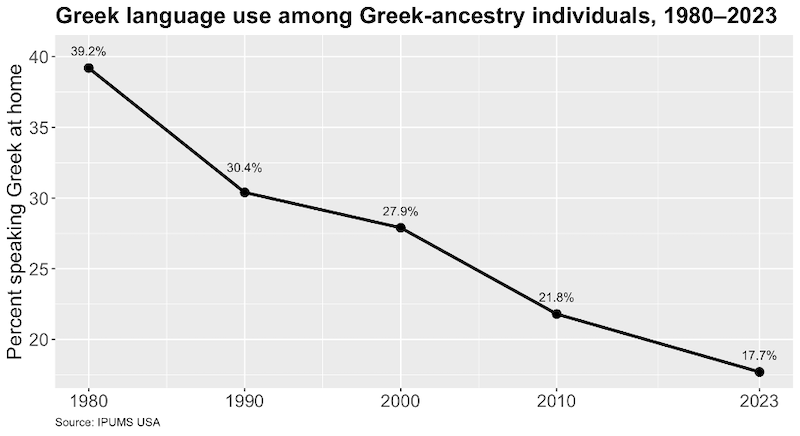
Figure 1 documents the long-term changes in the share of Greek-ancestry individuals who report speaking Greek at home between 1980 and 2023. The results reveal a clear and sustained decline in the use of Greek over the period.
Overall, we see a 21.5 percentage-point decline in Greek language use at home between 1980 and 2023. This corresponds to a decline of approximately 55%. It should be noted, however, that the rate of decline is not uniform across the decades. The sharpest decline occurred between 1980 and 1990, while the subsequent decades show a more gradual but steady attrition of Greek-language use.
Figure 1
Greek Language Use by Nativity among Greek-Ancestry Individuals, 1980–2023
Figure 2 presents trends in Greek-language use at home among those reporting Greek ancestry, distinguished by nativity status (born in Greece versus not born in Greece).
The results show a clear and persistent difference in language retention by nativity.
Among individuals born in Greece, Greek-language use at home remains high but declines modestly over time, from 91.4 percent in 1980 to 82.2 percent in 2023. This corresponds to an approximate 10% decline. In contrast, Greek-ancestry individuals not born in Greece report much lower and more quickly declining Greek language use at home, falling from 25.2 percent in 1980 to 11.5 percent in 2023—a 54% decline.
Figure 2
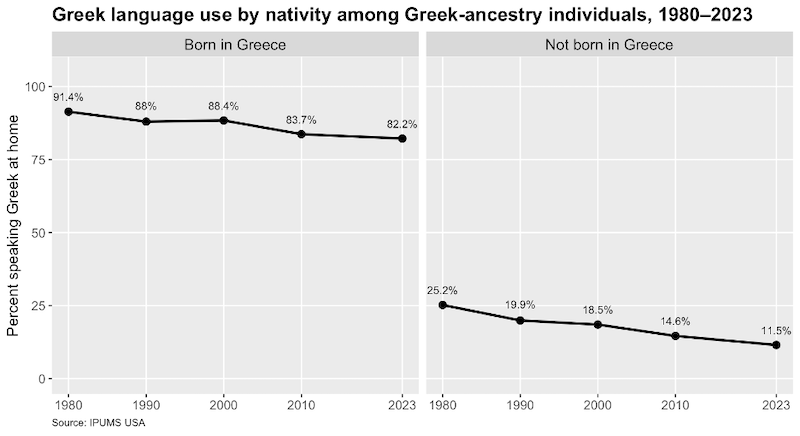
Overall declines in Greek-language use are mostly driven by changes among Greek Americans born outside Greece, not by the Greek foreign-born. While Greek is still commonly spoken at home by those born in Greece, it has become much less common among the U.S.-born and other non–Greece born groups.
Regional Trends in Greek Language Use, 1980–2023
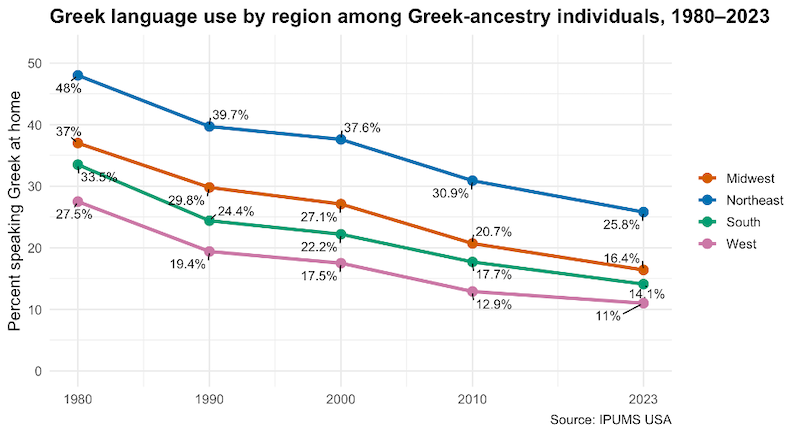
Figure 3 shows that Greek language use at home declined across all U.S. regions between 1980 and 2023. The Northeast consistently had the highest levels of Greek-language use, while the West had the lowest, with the Midwest and South falling in between. Despite regional differences in levels, all regions experienced a steady downward trend over time.
With respect to relative percentage change, the West experienced the largest decline, followed by the South and the Midwest, with the smallest decline in the Northeast.
Figure 3
Grigoris Argeros
February 04, 2026
Grigoris Argeros is a professor of sociology at Eastern Michigan University whose research focuses on demographic change, race and ethnicity, and urban and suburban changes in the United States. He is the creator and author of Greek America by the Numbers, a website that uses data to explore demographic, social, and economic trends among Greek Americans. More information can be found at https://www.greekamericabythenumbers.com/.