
Parading Loyalty Diaspora, Display and the Recoding of Greek National Day
by Dean Kalymniou
The commemorative grammar of Greek National Day within the diaspora has undergone a subtle yet profound mutation over the course of the years. What once functioned as a ritual of historical recollection, anchored in the violent and improbable renascence of a subjugated people, now increasingly performs another function altogether: the demonstration of loyalty to the host polity. The symbolic language of liberation may persist, yet its structure has been reshaped, reframed, and subordinated to a parallel narrative in which Greek independence becomes intelligible primarily through its capacity to affirm the ideological priorities of the dominant culture.
This transformation arises from structural conditions long identified within postcolonial thought. The subaltern speaks within systems that determine in advance the limits of intelligibility. Expression is permitted, yet it must take a form that can be recognised, processed, and sanctioned. The Greek diaspora, particularly in Anglophone settler societies, occupies precisely such a position. Visibility is granted within boundaries, and celebration is encouraged within a framework that reinforces the myths of the host nation. This shift may be understood, in Raymond Williams’ terms, as emergent rather than fully formed. It does not displace earlier meanings so much as reorganise them, exerting pressure upon inherited modes of commemoration. What is visible is a reorientation in which established narratives of liberation are drawn into a framework that privileges recognition within the host polity over historical autonomy.
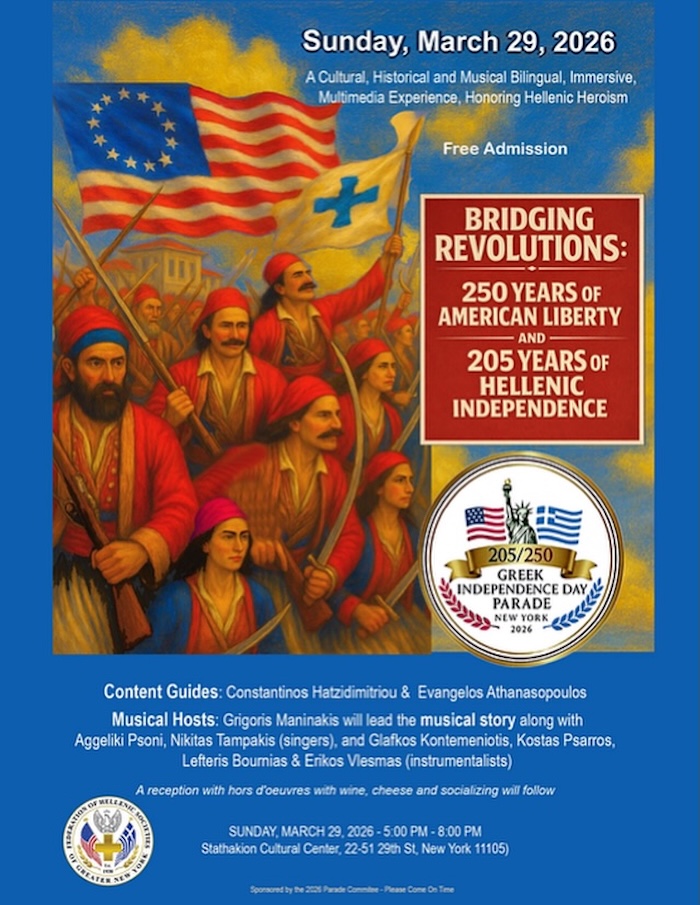
The promotional image for the Greek Independence Day Parade in New York condenses this process into a single visual field. Its aesthetic announces itself as synthetic, an AI-generated tableau in which historical verisimilitude yields to symbolic ordering. The American flag occupies the central axis of the composition, rendered large, vivid, and dominant, establishing visual sovereignty. The Greek flag appears diminished, reduced in scale and relegated to a secondary position, functioning as an accessory rather than as a foundational symbol. A hierarchy of importance is immediately established.
This is myth in the sense articulated by Roland Barthes: a system of signification that naturalises ideology. The composition transforms a contingent political arrangement into an apparently self-evident truth. American liberty emerges as the origin point of legitimate freedom. Greek independence appears as a subsequent articulation within that already established moral universe. It is the scale of the flags that performs this hierarchy. The accompanying text reinforces this visual logic. “Bridging Revolutions: 250 Years of American Liberty and 205 Years of Hellenic Independence” establishes a temporal asymmetry that carries ideological weight. The Greek Revolution is relocated within a timeline that is not its own, interpreted through a chronology that assigns precedence to another narrative of freedom. Dipesh Chakrabarty’s call to provincialize dominant histories finds an inverse expression here, as Greek history is rendered secondary within an American temporal frame.
What is suggested here approaches more than alignment. It intimates an equivalence in which Hellenism is recast as a variant expression of Americanism, its historical specificity absorbed into a broader ideological continuum.1 Greek independence no longer stands as an autonomous rupture but is rendered intelligible through its proximity to American liberty, from which it appears to derive both meaning and legitimacy. The semiotics of the image thus announces a new direction. Its function extends beyond representation into the political field, where Greek American institutions negotiate visibility and influence in relation to state power, particularly in proximity to Albany. In this context, the recalibration of symbolic hierarchy reflects an orientation toward forms of expression that align with the expectations of those structures within which recognition is sought.
Recent tensions surrounding the marginalisation of the Parade Committee at the State Capitol event, and the absence of substantive reference to the Greek Revolution itself, suggest that narrative authority is shifting away from community structures toward political actors whose priorities lie elsewhere. Commemoration becomes less a matter of historical articulation and more a function of positioning within institutional frameworks. Yet this articulation does not exhaust the field. Other forms of commemoration persist alongside it, preserving different emphases and resisting full incorporation into this emerging framework.
Within the American context, this process acquires an additional dimension. Greek American identity has long been sustained through narratives of recognition by the United States, narratives that foreground philhellenism while leaving unexamined the settler colonial foundations upon which such recognition rests. The incorporation of figures such as Ypsilanti into American civic mythology coincides with histories of Indigenous dispossession that remain largely unarticulated.2 The alignment of Greek independence with American liberty thus risks reproducing, rather than interrogating, the structures through which such histories have been obscured.
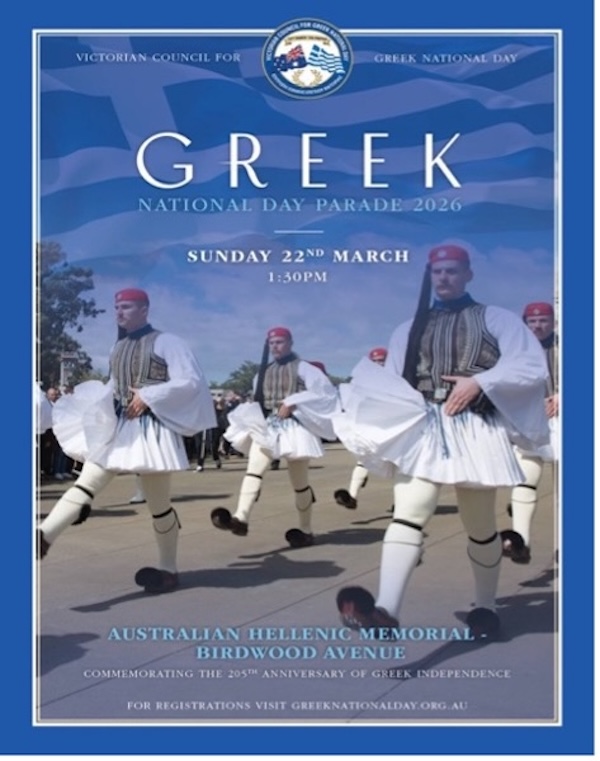
A comparable dynamic unfolds within the Australian context, albeit with a slower and more uneven trajectory. The emblem of the Victorian Council for Greek National Day begins with the Australian flag, positioned as the primary signifier of belonging, despite the Council’s stated purpose of commemorating the 25th of March as the day on which Greece celebrates its independence, history, and cultural heritage. The mission statement contains no reference to Australia, yet the symbolic apparatus foregrounds it, establishing the interpretative horizon within which Greek identity is presented.
At the same time, traces of resistance remain visible. Promotional material depicting Evzones marching beneath a Greek flag preserves a degree of historical continuity. The Greek flag retains its centrality within that imagery, anchoring the representation in a recognisable narrative of national memory and indicating that the process of recoding remains incomplete. The impulse toward self-representation persists, even as it operates within increasingly regulated environments.
These environments impose constraints that extend beyond symbolism. The relocation of the Melbourne parade from the Shrine of Remembrance to Birdwood Avenue signals a broader process of marginalisation. A site once associated with national commemoration is no longer available to non-Anglo Australians. The event unfolds at the edge of that space, both geographically and symbolically. In this way, the Shrine functions as a curated apparatus of sovereign memory, a lieu de mémoire in Pierre Nora’s sense, within which the state determines the forms and limits of legitimate remembrance. Speech within that space is governed. Reports that speakers at the invitation-only wreath laying ceremony are directed to confine their remarks to themes of Greek Australian friendship illustrate the mechanisms through which expression is channelled and commemoration is redirected.
Such redirection reshapes the nature of speech itself. In Gayatri Spivak’s formulation of the subaltern condition, speech is mediated through structures that define its permissible content. The community articulates its presence through a vocabulary that has been pre-approved, while expressions that foreground conflict, rupture, or independent interpretative frameworks encounter resistance at the level of form.
The historical substance of the Greek Revolution intensifies the significance of this restriction. The revolution was marked by violence, internal division, and geopolitical entanglement. Its narrative contains contestation as much as cohesion. Within diasporic commemoration, these elements recede as emphasis shifts toward harmony, continuity, and shared values. Conflict is displaced and the resulting narrative is rendered compatible with the expectations of the host polity. In the process, the revolution is stripped of its original conditions of risk, rupture, and uncertainty. What remains is a stabilised narrative, one that can be commemorated without disturbance, its disruptive force rendered compatible with ceremonial form.
The effect extends into the internal life of the community. Organisers operate within a matrix of financial obligations, regulatory requirements, and institutional expectations. Permits, insurance frameworks, public liability conditions, and funding structures shape the field within which events can occur in the dominant culture’s public domain. Where compliance becomes materially incentivised, the state structures the conditions under which only compliant expression remains viable. Within this matrix, anticipatory conformity emerges as a rational response, as organisers and participants calibrate their actions in advance and perform what they understand will be acceptable.
In this configuration, commemoration assumes the characteristics of spectacle. The increasing reliance on influencers, media promotion, and curated imagery signals a shift from memory as reflection to memory as content, designed for circulation, visibility, and consumption. What is produced is an image calibrated for recognition. At the same time, the growing prominence of donors, political figures, and institutional stakeholders, points to a reconfiguration of authority in which the articulation of historical meaning is mediated through elite structures. Memory becomes managed, shaped by those who control access, funding, and platform.
The analysis advanced by George Vassilacopoulos and Toula Nicolacopoulou illuminates the deeper structure of this condition. In From Foreigner to Citizen: Greek Migrants and Social Change in White Australia 1897–2000, they identify the paradox through which migrant communities are encouraged to establish their own institutions while the terms of that establishment are externally regulated. They extend this analysis by identifying the ontopathology of the ruling group as a constitutive factor. The regulation of migrant expression emerges from a deeper need to stabilise a settler society founded upon dispossession. Authority is reaffirmed through the management of difference. By positioning itself as arbiter of acceptable cultural forms, the state legitimises its own historical narrative. Migrant communities are incorporated into this process as regulated participants, included within the national imaginary while remaining subject to its disciplinary structures.
Recent decolonial scholarship extends this analysis further. As Andonis Piperoglou has argued, diasporic celebrations of 1821 within settler colonial societies often privilege narratives of civilisational continuity and democratic inheritance, while leaving unexamined the position of Greek migrants within structures predicated upon Indigenous dispossession. Celebration, in this context, displaces reflection, aligning Hellenism with the legitimising myths of the host state. Such positioning also facilitates selective recognition, in which Greeks are valorised as bearers of a classical civilisational legacy, enabling their incorporation as a model minority, while other migrant presences remain marginal or unacknowledged. Recognition is structured by the hierarchies embedded within the host society itself.
Greek National Day becomes a site at which these dynamics converge. The language of celebration is shaped by the need to secure recognition. Democracy and liberty are invoked as shared values, functioning as symbolic currency and facilitating participation within the host nation’s narrative, while displacing the particularities of Greek historical experience. The spatial dimension of diasporic commemoration underscores these dynamics. In New York, the parade occupies a central public space, visible to a broad audience, even as it reproduces a hierarchical narrative. In Melbourne, the parade proceeds along the margins, unfolding away from principal sites of congregation, with the audience consisting largely of participants themselves.
The resulting spectacle takes on the character of a pantomime, in which the forms of commemoration are preserved while their content is regulated, and the parade advances within fixed boundaries as participants don the foustanella and tsarouhia, enact the gestures of historical memory, and disperse once the ritual concludes, affirming continuity even as the limits imposed upon it remain visible.
What recedes in this process is sustained engagement with the meaning of the Greek Revolution itself, which remains available as a site of inquiry into the relationship between past and present, the unfinished character of liberation, and its resonance within contemporary struggles, yet is confined to a narrow and sanctioned vocabulary that limits interpretation in advance. Within these conditions, autonomy is constrained by design, as the incentives for conformity and the consequences of deviation shape expression before it occurs, even while residual forms of resistance persist in the continued presence of symbols, memory, and communal practice. What is ultimately at stake is not simply how the revolution is remembered, but who determines the terms under which it may be spoken, and to what ends that memory is made to serve.
The event still holds the possibility of reflection, of returning to 1821 as an open question rather than a settled emblem, and of situating that struggle within a wider horizon of unfinished liberation. Realising that possibility requires a departure from sanctioned language and a willingness to speak beyond expectation, even as the structures identified by Vassilacopoulos and Nicolacopoulou continue to organise the limits of expression and reward conformity. The persistence of symbols, memory, and historical reference indicates that recoding has not achieved closure. The question is whether the community will reclaim its narrative or continue to rehearse it within prescribed terms, allowing the memory of liberation to endure in form while remaining subordinate in meaning.
March 21, 2026
Dean Kalymniou is an intellectual, a writer, a poet, a playwright, a lawyer. He lives in Melbourne, Australia.
Notes
1. For a historicization of Greek American identity narratives dovetailing with national (American) ideals see Yiorgos Anagnostou. 2021. “A Paradigm Award, A Paradigm for Greek/American Cultural Policy.” Erγon: Greek/American & Diaspora Arts and Letters. August 3. Along these lines, on the ideology of Greek America as a model ethnicity conforming to national norms see Yiorgos Anagnostou. 2003. “Model Americans, Quintessential Greeks: Ethnic Success and Assimilation in Diaspora.” Diaspora: A Journal of Transnational Studies. Vol. 12 (3): 279–327.
2. See Artemis Leontis. 2021. “Visiting the Statue of Ypsilanti in Michigan on Martin Luther King Jr. Day.” Ergon: Greek/American & Diaspora Arts and Letters. January 18.