
The Long Shift
by Vasilia Kourtis-Kazoullis
He was twenty-five when he left:
a borrowed coat, a small suitcase,
the village road still clinging to his shoes.
No blessing, no promise.
Only a ticket with his name on it,
and the smell of winter rain.
In Ohio the air was iron.
The mills burned night into morning,
the furnaces breathing red,
the heat folding men into its pulse.
He learned to read the tremor of machines,
the silence that held its breath.
Each day he stood at the line,
his body answering metal.
He did not know the language,
only the orders shouted over the machines—
numbers, gestures, the clang of command.
He learned to nod, to understand by rhythm,
to keep his silence steady as the floor.
The years forged his hands—
bones turned, fingers drawn inward,
fixed in the motion that fed the line,
as if the work had melted them.
He never spoke of the noise,
nor the grinding monotony
or the long hours,
how the shift’s end came
like disbelief.
His letters home were brief:
a few dollars folded inside,
his name written carefully,
the paper sealed with the dust of work.
The years passed.
The mills fell silent one by one,
and he carried their fire inward
like a small sun
slowly setting in his chest.
*
Now he is ninety-five,
back in the same village,
the same stones underfoot.
He walks with slow, uncertain balance,
as if the ground is moving beneath him.
He sits outside his ancestral home
in the old wooden chair,
the hills behind him
rising and falling like breath.
As dusk settles,
he waits for the last spark of light
to slip behind the ridge’s curve,
where color deepens before it yields—
a hush of gold, then rose,
then the tender blue that joins them both.
His hands rest open on his lap,
scarred, certain,
still marked by labor.
He seldom speaks of Ohio.
That life has grown distant
as a name rubbed smooth.
He talks instead of olives and rain,
how the branches used to bend with fruit,
how the nets were spread beneath the trees,
how his hands came home stained, shining.
Inside, the icons watch from the walls,
gold leaf dimmed by smoke,
Byzantine faces, grave in their fading colors.
The same light that touched the groves
gathers now in their eyes.
He says the Archangel visits sometimes,
a quiet shimmer at the edge of sleep,
not with fire but with grace,
the hush after the day’s long work.
Outside, the wind rustles the leaves of the olive trees,
or is it the Archangel spreading his wings,
lifting his dagger?
The moon moves softly, decisively, through the room,
as he closes his eyes
and lets night pass through him.
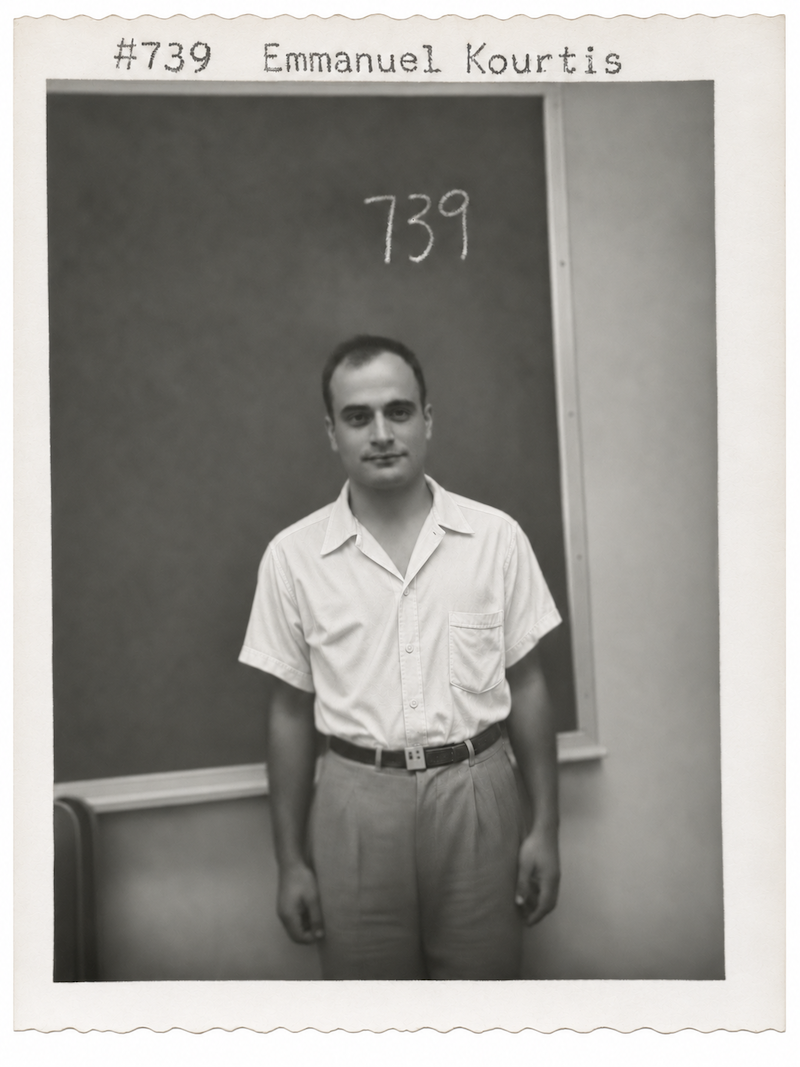
Author’s Note: “The Long Shift” is for my father, Emmanuel Kourtis (1933–2026). As a young man, he left Asclepios, his village on the Greek island of Rhodes, to work in the steel mills of Ohio. The photograph comes from the mill where he worked, in Warren, OH. It was taken in 1959; his name and number, 739, appear at the top.
Vasilia Kourtis-Kazoullis is Professor Emerita in the Department of Primary Education at the University of the Aegean in Rhodes, Greece. Her teaching and research focus on bilingualism, second-language education, teacher education for multilingual classrooms, and the use of technology in language learning. She has written extensively in these areas and edited books on language learning and linguistic diversity. Her publications include the monograph «Μια μικρή αφήγηση, μια μεγάλη ιστορία: Ένας Ροδίτης μετανάστης στις ΗΠΑ το 1920» (Papazisis 2018).