
The “Global Hellenic”: Constellations, Diaspora, Transcultural Relations
by Yiorgos Anagnostou
[Constellations lead] the past to bring the present into a critical state.
— Walter Benjamin 1999
The “significance” of the idea, Benjamin further explains, “can be illustrated with an analogy. Ideas are to objects as constellations are to stars.” Ideas are related to historical objects, in other words, in the way that points of light in the night sky resemble recognizable phenomena. It is their configuration, their spatial interrelationship, which allows for meaning and recognition.
— Norm Friesen 2013
Abstract
This article proposes a method for reading the past alongside the present to conceptualize the global significance of transnational Greek diasporic culture. The framework interconnects two core concepts: the “Hellenic,” defined as broad cultural learning rooted in affiliation rather than descent, and the capacity of the arts and humanities to inspire a reflexive fashioning of the self and to produce generative, cross-cultural dialogue. Utilizing select insights from Walter Benjamin, the analysis links archival fragments (such as poems, translations, interviews, and commentaries) with contemporary social practices, including theatrical performances and interactive ethics seminars. By pairing these elements with theoretical approaches to theater and subjectivity, the work charts a new constellation: the global Hellenic. When this configuration encounters diverse, multireligious audiences, it corresponds directly to Benjamin’s emphasis on the political work of a constellation. By redeeming neglected or discarded pasts, the discussion of this analytical model contributes new pedagogical perspectives toward cultivating transcultural modes of thinking and living. Creative, inventive, generative, and civic-minded, the global Hellenic animates a specific ethics and politics, deserving our attention as a force that empowers the global relevance of diasporic heritage and practice, as well as a source for further fostering transnational Hellenic constellations.
***
In a historical moment marked by aspirations to establish the global relevance of Greek culture, how can we imagine a framework beyond nation-centric renditions, focusing instead on transnational circulations, cross-cultural connections, and intercultural dialogue? Given the diaspora’s enduring engagement with these processes, what insights do we gain when we place its cultural production at the center of our inquiry?
A distinct, cosmopolitan intellectual lineage offers an apt departure point for the investigation. Such a heritage emphasizes learning and a fundamentally outward-looking cultural orientation. From that perspective, the diaspora becomes a dynamic agent in reframing Greek globality as a generative dialogue across difference.
How does this inheritance interconnect with the global present? This study draws on select insights from Walter Benjamin’s concept of the “constellation”—a method of reading archival texts as vital resources for thinking about the contemporary moment. The analysis comprises two interrelated dimensions. First, it connects a host of scattered facts (the “stars” in the celestial configuration) across space and through specific historical moments. This mapping draws upon textual fragments, including poems, translations, interviews, commentaries, and interpretations, to illuminate the making of diasporic subjectivities outside ethnocentric frameworks.
Second, the analysis shifts focus from a transnational diasporic framework to an international one. This expansion introduces additional elements that deepen the constellation’s density and texture: social practices, such as theatrical performances and interactive ethics seminars, alongside scholarship produced in the United States and Greece, as well as theoretical approaches to the politics of theater and transculturalism. By widening the analytical lens, the study examines the effects of this denser configuration, identifying its unique political function when it encounters and enters into dialogue with other cultures.
The juxtaposition of these materials elucidates a concrete expression of this inheritance, which is currently endangered by prevailing nation-centric narratives. This configuration highlights a historical persistence within the diaspora as it asserts its cultural self-determination. Consequently, it shifts the conversation away from narratives that reduce the diaspora to a descent-centered identity, national purity, idealization, or mere aesthetic appreciation. Instead, it recognizes the core elements associated with diasporic Hellenism: self-reflexivity, biculturalism, the agency of cultural becoming, and civic activism in a new home.1
This configuration takes on additional meaning when it encounters multiethnic and multireligious audiences. It aligns directly with Benjamin’s (1996–2003) emphasis on the political work of a constellation. Here, the objective is to analyze a cross-cultural engagement in which an individual experiences a flash of recognition—a moment where a past she was unaware of intersects meaningfully with her present reality. Through this experience, the past resonates with the present, redeeming what has been neglected or deliberately cast away.
Analyzing this redemption illuminates a related danger: the power of cultural and religious nationalism to erase competing pasts. This insight prompts the central inquiry of the study: how the conceptual configuration outlined here operates in global discussions regarding pedagogies that cultivate transcultural modes of thinking and living. The arts and humanities are central to this endeavor, inspiring the reflexive fashioning of the self and producing generative cross-cultural dialogue.
The “Global Hellenic”
I call the constellation charted here the “global Hellenic.” The first term, “global,” signals its international circulation and the ways in which it engages not only the diaspora but also multiethnic audiences.
The term “Hellenic,” however, requires elaboration. At first glance, as an adjective, it is used as a political identity marker, reflecting the official form of Greece’s self-ascription: the Hellenic Republic. The term has been historically linked with official political membership in the nation (Elliniki ypikootita), which until recently connected the right to citizenship to ethnic descent.
By contrast, when rooted in the archival usages of the term as a noun, the Hellenic within the selected texts transcends these connotations. It signals an alternative mode of cultural and political affiliation beyond descent, referring to a framework in which elements of the Greek literary and cultural inheritance intersect with other intellectual traditions. Consequently, the Hellenic replaces descent and national boundedness with transcultural openness.
The global Hellenic raises questions regarding the significance of Greek transnational culture. How does this constellation circulate? Who disseminates it, to what purpose, and to what effect?
I trace the meaning of the Hellenic in the work of three diasporic figures whose lives span a variety of historical periods, geographical spaces, and varying cultural contexts: the Greek Alexandrian poet Constantine Cavafy (1863-1933), the Greek American poet George Economou (1934-2019), and the transnational Greek director, actor, and playwright Yannis Simonides (b. circa 1955). The constellation I chart connects fragments from their cultural production and its reception: a stanza composed in Alexandria, Egypt, in 1923; a two-line poem crafted in 2015; a commentary by a translator in 2009; a statement recorded in an interview in Queens, New York, in 2023; and a solo theatrical performance and its accompanying workshops, staged around the world.
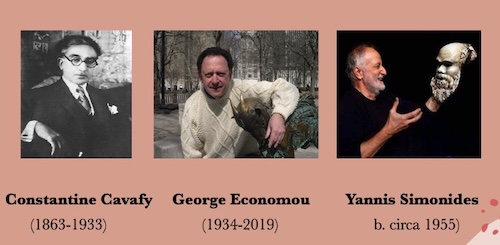
The three poets and artists whose writings and performances animate the constellation in this analysis lived and created in different diasporic environments. Cavafy’s biography is marked by geographical mobility, though the center of his poetry-making was Alexandria, which hosted during his time a vibrant, Greek-speaking social and literary community whose middle class enjoyed privileges in the context of European colonialism.
Economou worked within the academy and US literary circles—as a poet, scholar, and translator whose diasporic “ambivision” connected Greek and American cultural worlds, including his translation of Cavafy into English (Jennet 2007). In addition to experiencing American nativism firsthand, he wrote about it.2 Conversely, Yannis Simonides aligns more closely with contemporary US multiculturalism; as a theatrical director and internationally touring actor, he maintains ties with Greek life in Queens, New York, and Athens, Greece.
When viewed comparatively,3 their distinct linguistic and institutional orientations become clear. Cavafy wrote in Greek for a select audience; Economou published in English and largely operated outside Greek American parish life; and Simonides employed bilingualism to reach Greek-speaking and global audiences. Consequently, each occupied a variety of subject positions and navigated different social milieus. Yet, collectively, they contribute to the intellectual lineage animating the global Hellenic.
The Hellenic: Beyond Descent
I enter the terrain of the global Hellenic through a figure who self-identifies as Hellenic and is widely recognized as a global Greek: the actor, director, scholar, and writer Yannis Simonides, who was honored by the city of Athens in 2009 as an “Ambassador of Hellenism for his lifelong service to Greek culture worldwide.” He is celebrated internationally for Socrates Now, his solo theatrical rendition of Plato’s The Apology of Socrates.
Simonides is affiliated with Elliniko Thεatro, a transnational performing arts organization founded in 1979, in New York City, with offices in Athens, Greece. Its outreach is international, spanning performances in over 50 countries. Praised as the “most accomplished theater of the Greek diaspora,” the organization “aims to serve as an innovative carrier of cultural diplomacy, expanding the temporal, spatial, and social boundaries of Hellenic Theatre.” Its ambitious programming deliberately engages multiethnic audiences.
Two mottos embraced by Simonides—one associated with his self-ascribed identity and the other connected with his philosophy of living—will guide my exploration of the scope and ethical compass of the Hellenic. In an interview for the Hellenic American Project at Queens College, Simonides articulates his cultural affiliation by aligning himself with Constantine Cavafy, a Greek diasporic poet of enduring international stature. He asserts, “I feel like Cavafy: ‘Hellenic’ [Ellinikos], not ‘Greek’ [Hellene (Ellin)/Ellinas].”
This statement directly echoes a famous remark attributed to Cavafy—one that stresses the difference between the two identity markers, “Greek/Ellin” and “Hellenic”: “I, too, am Hellenic [Ellinikos]. Mind you, not Greek [Ellin], nor Grecified [Ellinizon], but Hellenic” (quoted in Mendelsohn 2009, 434).
What does this differentiation mean, and why does it matter? For insights, I turn to C.P. Cavafy’s poem “Epitaph of Antiochus, King of Commagene” (1923), translated into English by Daniel Mendelsohn, whose commentary on the semantic nuances of rendering the word Ellinikos unpacks this exact distinction. The poem concerns the circumstances leading to the production of the historical epitaph honoring Antiochus. This ruler—most likely Antiochus I—governed the Hellenistic kingdom of Commagene under the expansive title Antiochus Theos Dikaios Epiphanes Philorhomaios Philhellene (“Antiochus, the just, eminent god, friend of Romans and friend of Greeks”).
May the renown of Antiochus the benevolent king
be meetly extolled, O Commagenians.
He was the provident captain of the land.
The life he lived was just, and wise, and gallant.
The life he lived, still more, was the finest thing: Hellenic—
mankind holds no quality more precious:
among the gods alone does anything surpass it.
The epitaph in the poem exalts the Hellenic as a supreme cultural value, though it refrains from defining it. The text centers on performative praise of Hellenism produced by a sophist with a Greek name who wished to repay the “royal hospitality” Antiochus had extended to him. After consulting with courtiers, the sophist composes a “eulogy most likely to please the sister of the deceased monarch’’ (Halim 2013). As the product of an elite, the panegyric in the epitaph exhorts the subjects of the kingdom—independently of ethnic descent—to embrace and glorify the Hellenic.
The poem transports the reader to the Hellenistic era, a period that served as a primary locus of Cavafy’s exploration of cross-cultural and ethnic mixing. Commagene, in particular, combined Greek and Asian elements—a fusion expressed in the grandiose funerary monument Antiochus erected for himself, depicting the monarch “seated among colossal images” of Persian and Greek gods. This hybridity allowed the poet to reflect on the standing of Hellenism in these multiethnic and declining kingdoms (Mendelsohn 2009, 434).
Mendelsohn elucidates his choice to render the original Ellinikos as Hellenic:
The word I have translated as “Hellenic,” ellinikos, is a particularly resonant one for Cavafy, with subtle and complex overtones. It suggests, […] a person of broad Greek culture––not, that is, merely someone who is Greek by nationality, which could easily have been suggested by the words Ellin, the usual Greek word for “Greek.” Not “a Greek,” then, but “Hellenic,” in outlook, culture and taste; a state of mind rather than a nationality (434).
Used in this manner, the Hellenic signals a mode of cultural affiliation distinct from the usages of Greek identity in modernity. The latter is conventionally tied to nationality and membership in the Greek nation based on ancestry, denoting filiation. The former, instead, privileges cultural identification beyond descent in the context of multiethnic societies. It is this broader sense that makes the term an apt lens for situating Greek culture and its significance within contemporary globality.
The Hellenic: The Ethic of the Examined Life
What does the Hellenic mean for Simonides? For an answer, I return to the second motto he evokes—a philosophical one—the familiar dictum attributed to Socrates: “The unexamined life is not worth living.” “If you do not explore [life], if you do not examine it,” Simonides translates this saying, “you might as well go die” (Delikonstanidou 2020, 211). Notably, this rendering of the dictum presents a harsh imperative for those who have no interest in pursuing the examined life. By contrast, Richard Kraut’s (2006) competing translation articulates the ethic of the examined life in a non-punitive manner: “No human being should live an unexamined life” (231).
These textual fragments provide a comprehensive view of the twin meanings attached to the Hellenic within this specific vector of the constellation. The concept denotes, first, a broad connection with Greek culture beyond nationality and ethnicity, and second, an ethic of the examined life. To explore how this intersection between the Hellenic and Socratic self-examination links to another textual fragment in the configuration, I turn to a selection from George Economou’s oeuvre.
Like Simonides, Economou exhibits great erudition regarding both the Hellenic inheritance and the ethic of the examined life—two domains he explicitly interconnects. In his two-line poem “All-American” (2015), the poet situates Socrates’s dictum in relation to American ethnicity:
The Unexamined Ethnic Life
Is not Worth Living.
This brief poem assigns an all-American status to ethnicity, a paradoxical association given that the particular (ethnic life) is equated with the universal (the dominant national identity). In the social sphere, these two modes of belonging—ethnic and American—often exist in tension, even conflict, particularly in contexts that demand assimilation or restrict the scope of ethnic expression.
This tension forms a central drama in American society, as Warner Sollors (1986) points out in his classic study of ethnicity, in which the cultural demands of ethnic and American identity frequently pull an individual in opposing directions. Yet the poet places the all-American and the ethnic together in harmonious cohabitation. How does this come to be?
Such coexistence emerges through the practice of the examined ethnic life, in which the individual is capable, through self-reflection, of fashioning a hyphenated identity that accommodates both these cultural dimensions. It is no coincidence that Economou (2000) visualizes the diasporic self through the image of the Roman god Janus.
The metaphor centers on a position from which one simultaneously looks in multiple directions, surveying the various heritages and cultures that shape subjectivity. The examined life requires that the individual exercise care when evaluating the range of resources available for self-fashioning and apply judgment in selectively embracing those deemed of value.
The Hellenic and the Examined Life: Agency and Global Implications
Economou’s poetic corpus enables the shaping of a cultural identity and the negotiation of self-becoming. This process involves the poet’s engagement with a vast archive from which he selectively draws disparate forms, genres, and historical fragments to fashion a singular poetic self. In doing so, it equips readers to assemble their own subjectivities through the operation of Vasilis Lambropoulos’s (2020) concept of “transcomposition”:
[Economou] draws on sources such as myth, folktale, history, song, and papyri fragments. He uses highly structured poetic forms such as the pantoum, villanelle, and sestina. He writes in poetic, narrative, and scholarly registers with corresponding typographical arrangements.
All these mobilized modalities generate pieces of identity, and readers are invited to assemble them in a meaningful whole. They can be made to fit together in different ways so the outcome is not predetermined and results may vary. The point is not to reconstruct a fixed Greekness but to assemble a viable, generative one.
The performance of transcomposition aligns with the principles of the examined life as outlined in the Socratic dialogues, particularly in Plato’s Ion and Gorgias. The reflexive making of the ethnic self resists externally imposed definitions of ethnicity from above, whether driven by institutions, ideological apparatuses, or grand narratives. Such self-fashioning is inherently political: it opposes these prevailing forces, refusing to surrender one’s life “to the governance of others” (Kraut 2006, 235). Instead of passively submitting to what is assigned and predetermined, the individual asserts its agency through self-governance.
Economou’s ethic of examining ethnic life turns away from the prevailing topoi of attachment to an ancestral place, its costumes, and its customs. Further, he has no interest in discourses that define ethnicity as a cultural whole. Rather, his poetics performs the Hellenic in the manner of Cavafy—as broad cultural literacy; indeed, it involves deep Greek as well as cosmopolitan learning. This performance mirrors what Lambropoulos (2020) describes as “the transcomposition of an examined life,” which “assembles and arranges heterogeneous elements from various sources to fashion an entirely new well-tempered βίος/life, a unique harmony never heard before yet perfectly self-consistent and transcendent.”
This iteration of the Hellenic carries global implications and applications. By bringing together ancient and modern Greek sources as well as various poetic genres and forms, Economou positions his poetry to engage diverse Anglophone audiences. This reception spans scholars of classics and poetry enthusiasts to those drawn to the poetics of immigration, as well as diasporic readers themselves. His corpus invites them to actively engage with his corpus, combining and recombining its elements in new arrangements, thus creating novel meanings and fresh identifications for themselves. His work offers a quintessential illustration of identity as becoming.
Crucially, the intersection of the Hellenic and the examined life fosters the development of reflective individuals—a dynamic Simonides deepens by introducing a dialogic and transcultural dimension to the staging of solo performance.
The Global Hellenic: Social Theater and Dialogical Reflexivity
To explore this interplay, I examine Simonides’s theatrical rendition of the Apology of Socrates. As the scholar Aikaterini Delikonstantinidou (2020) illustrates, this performance broadens the global Hellenic by bridging the poetics and politics of the examined life with Bertolt Brecht’s approach to theater. By discussing Simonides’s project in relation to Lambropoulos’s framework of transcomposition, her analysis highlights a performance method that structurally mirrors Economou’s own composite approach to poetics. Simonides deploys a parallel strategy of weaving together diverse cultural resources—an ancient philosopher, a modern Greek poet, and a German playwright. Just as Economou rejects a fixed cultural framework, Simonides activates these distinct historical threads, all within collaborative, multiethnic civic spaces.
This approach embodies the actor’s transnational ties to Greek theater, his erudition, and his academic work in the United States, which includes studying at Yale and teaching as a visiting professor at New York University. By blending Greek, diasporic, American, and other intellectual traditions, Simonides engages cross-cultural audiences.
Central to this project is Brecht’s social theater—an activist modality that prompts spectators to reflect on issues bearing on their personal lives and society. Simonides maintains that the performance of Socrates Now has no interest in instilling a single truth, nor does it aim to be didactic. Rather, the long-form Interactive Ethics Seminars he incorporates into the event put into practice the Socratic method of “asking questions, debating, arguing.” The production invites the audience to consider Socrates’s “arguments on virtue, justice, politics, corruption, civic duty, love of life and hope in death,” thereby creating a social space that promotes dialogic reflexivity. Here, the public is invited to draw its own judgments and discuss the ramifications of its verdict.4
The Global Hellenic: A Flash of Transcultural Recognition and its Political Work
Simonides prevents Socrates Now from turning into a generic global text. Rather than imposing an ecumenical truth on local cultures, he works to create a dialogue leading to mutual understanding. Grounded in a transcultural ethos of identifying commonalities across difference, his performances accommodate local particularities by introducing adjustments “to relate to the participants’ immediate sociopolitical and cultural context” (Delikonstantinidou 2020, 210).
Consequently, this outreach remains intrinsically attentive to regional nuances. Such cross-cultural fertilization animates the practice of transculturalism: “the productive yet not conflict-free merging and converging of disparate cultures beyond nation-states, at the heart of which lies the experience of seeing oneself in the other” (213).
This kind of transcultural encounter unfolds during a production held in the Middle East, reported by Constantine Sirigos (2011):
During the discussion […], a woman donning a black burqa asked Simonides, “I am a devout Muslim and you ’ve just told us things that I thought existed only in my Holy Book. And you posited they pre-existed it, by over a thousand years, in a pagan culture, nonetheless. […] Could [you] be ever so kind to help me marry the two in my heart?”5
Within this cross-cultural engagement, the global Hellenic produces a flash of recognition: the enacted past of one culture (pagan classical Greece) aligns with the present of another (a Muslim audience member). A consciousness of affinities emerges across difference, allowing commonalities to become visible where absolute dichotomies were previously assumed. This moment exemplifies the experience of seeing oneself in the other—an accommodation within the self of two belief frameworks often perceived as irreconcilable and frequent sources of conflict.
While nationalism draws rigid boundaries around a culture to posit an absolute, “pure” truth, transculturalism brings forgotten and erased alternative pasts to the fore to foster mutual cross-fertilization and understanding. By creating spaces where individuals of diverse cultural backgrounds can form expansive connections, transculturalism confronts the danger of an ideology that obliterates difference. This process engenders a meaningful intertwining of their lives rather than insular fragmentation.
The political work of the constellation is realized as it resists grand narratives of identity that impose a monolithic reality, thus redeeming marginalized pasts to cultivate an ethos of transcultural pluralism.
In Lieu of Conclusion: The Future of the Global Hellenic in the Diaspora and the World
The performativity of the global Hellenic animates the diverse dynamics traversing this constellation: learning, examining, reflecting, combining, assembling, encountering different cultures, incorporating “non-Greek” intellectual traditions, and becoming. It invites educators and scholars to excavate ideologically excluded pasts, ultimately rendering these histories visible and restored.
Through these attributes, this concept connects to current conversations about pedagogy. It speaks particularly to efforts aimed at shaping reflexive subjects through the recognition of mutuality and commonalities across difference. Moving away from standard dialectics of identity—where selfhood is acquired strictly in contrast to an external other—the global Hellenic becomes a practice that enables the self to recognize the other within itself, and itself within the other.
Here, pedagogy is understood as a transformative practice of mutual recognition. Through reflective dialogue, learners “build an alternative perspective on current issues” and “come to know and express themselves in ways that may not have occurred, had the educator not provided an opportunity, or necessity, for such articulation” (Bosio 2023, 179–180). Consequently, educators invite students “to recognize bonds based on shared traits,” thus encouraging them to act together on critical issues and contribute to the cultural and civic vitality of contemporary society.
Simonides’s project therefore offers a concrete paradigm for a generative global Hellenic. By combining texts and ideas drawn from Greek, diasporic, and other intellectual traditions, it demonstrates how erudition, self-reflection, ethical examination, and dialogic exchange can sustain intercultural civic conversations. It is precisely in this capacity that the global Hellenic constellation gains its transformative resonance.
Actualizing this concept through diverse modalities provides a crucial path forward for the diaspora. It positions Greek transnational cultural producers as vital agents of change across a wide range of settings. These encompass educational spaces—ranging from the undergraduate classroom and the graduate seminar to the academic lecture—as well as creative venues like the theatrical stage, the visual arts, the poetry reading, and the film festival. By inspiring individuals around the globe to engage with Greek texts in combination with other intellectual sources, these creators animate the historical archive into an active resource for transcultural understanding.
September 26, 2026
Acknowledgments
I have presented earlier versions of this work in two lectures: one in the Modern Greek Culture Lecture Series at the University of Chicago (2024), and the other in the Arthur G. Nikelly Annual Lecture, hosted by the Modern Greek Studies Program at the University of Illinois Urbana-Champaign (2026). I thank Anthony Kaldellis and Maria Hadjipolycarpou for their invitations, as well as my hosts and the audiences for the engaging conversations.
Yiorgos Anagnostou teaches at The Ohio State University.
Works Cited
Anagnostou, Yiorgos. 2026a. “Globalizing the Greek Diasporas: Contested Hellenisms.” Ergon: Greek/American & Diaspora Arts and Letters, September 5.
–––––. 2026b. “The Diaspora Cultural/Civic Paradigm: Arts, Policy, the Next Generation.” In Advancing Greek Heritage Language Education in Canada. The Hellenic Relay: A Community Action Study. Themistoklis Aravossitas and Marianthi Oikonomakou eds., 61–77. Springer.
Benjamin, Walter. 1999. The Arcades Project. Translated by Howard Eiland and Kevin McLaughlin, Belknap Press.
–––––. 1996-2003. Selected Writings. 4 vols. Belknap Press.
Bosio, Emiliano. 2023. “Global Citizenship Education as a Reflexive Dialogic Pedagogy.” Citizenship Teaching & Learning, Vol. 18, Issue Philosophical, Ethical and Pedagogical Visions of Global Citizenship Education: Critical Perspectives from International Educators, 177–94.
Delikonstantinidou, Aikaterini. 2020. “Socrates Now or the Apology Project: From Greek Roots to Transnational Routes.” Ex-centric Narratives: Journal of Anglophone Literature, Culture and Media, issue 4.
Economou, George. 2015. Unfinished & Uncollected: Finishing Cavafy’s Unfinished Poems followed by Uncollected Poems & Translations. Bristol, UK: Shearsman Books.
–––––. 2000. Janus Witness: Testament of a Greek-American Poet. Athens: American College of Greece.
Halim, Hala. 2013. Alexandrian Cosmopolitanism: An Archive. Fordham University Press.
Friesen, Norm. 2013. “Wandering Star: The Image of the Constellation in Benjamin, Giedion and McLuhan.” Paper presented at the 14th Jerusalem Conference in Canadian Studies, Hebrew University, Jerusalem.
Jeffreys, Peter. 2006. “Cavafian Catoptromancy.” Windows on Greece. University of Michigan, Department of Modern Greek.
Jennett, Matthew. 2007. “Double Vision.” Odyssey: The World of Greece, July/August, 40–42.
Kraut, Richard. 2006. “The Examined Life.” In A Companion to Socrates. Sara Ahbel-Rappe and Rachana Kamtekar eds., 228–42. Blackwell Publishing Ltd.
Lambropoulos, Vassilis. 2020. “What is Transnational about Greek American Culture?” Ergon: Greek/American & Diaspora Arts and Letters, February 17.
Mendelsohn, Daniel. 2009. C. P. Cavafy: Collected Poems. New York: Alfred A. Knopf.
Sirigos, Constantine S. 2011. “With Apologies from Simonides, Socrates Shows How to Live,” The National Herald, June 1.
Sollors, Werner. 1986. Beyond Ethnicity: Consent and Descent in American Culture. Oxford University Press.
Notes
1 On diasporic Hellenism and the cultural/civic dimension of the Greek diaspora, see Anagnostou (2026a, 2026b).
3 On this point see Jeffreys (2006).
4 The performance of Socrates Now at Princeton University, organized by the Seeger Center for Hellenic Studies (November 13, 2019) was followed by a panel discussion by eminent scholars in philosophy and political theory.